AI Valuation Audit - The Concierge Protocol
Buying a yacht in Hong Kong is a process of clearing friction layers. We are a buyer-side intelligence unit. We don’t represent sellers. We represent the math.


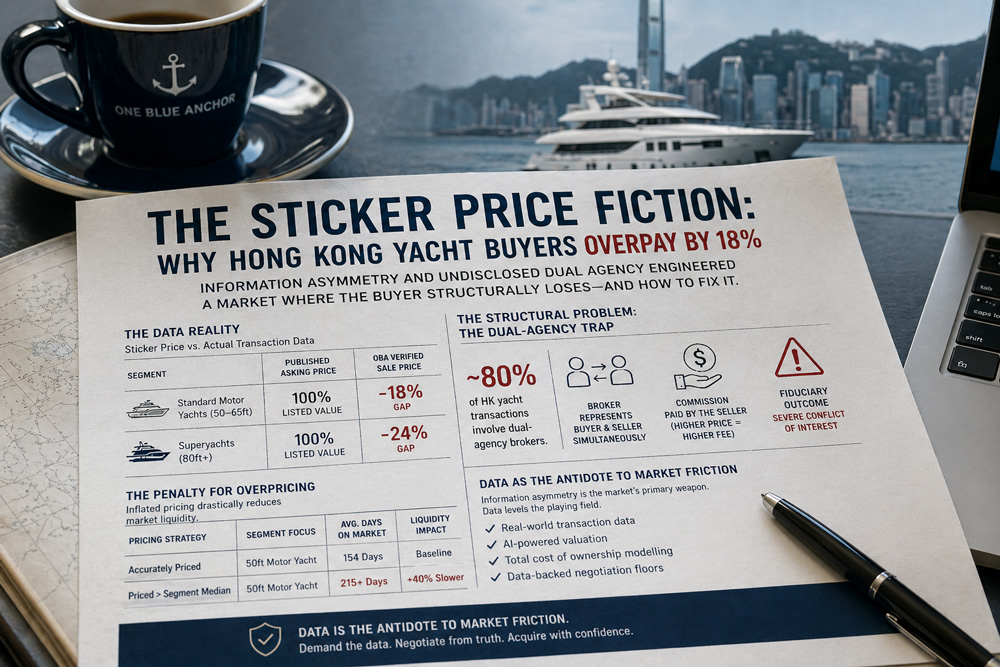
Market Intelligence
How information asymmetry and undisclosed dual agency engineered a market where the buyer structurally loses—and how to fix it.
In mature asset classes—equities, commercial real estate, fine art—markets rely on transparency to function efficiently. Pricing is determined by historical comparables, public ledgers, and audited transaction data. The Hong Kong yacht market, however, operates on a fundamentally different premise: engineered opacity.
For decades, the market has functioned as a black box. There is no public transaction record, no MLS equivalent, and no central database of sold prices. The only figures visible to a prospective buyer are the published asking prices.
Our proprietary intelligence reveals a stark reality: these sticker prices are not market valuations. They are inflated opening positions in a negotiation where the buyer is structurally designed to lose.
At One Blue Anchor, our AI valuation engine continuously scrapes, normalises, and cross-references listing data across the regional marketplace, benchmarking it against our proprietary ledger of verified, real-world transaction data. The numbers expose a market heavily skewed against the unrepresented buyer.
Published Asking Price
OBA Verified Sale Price
Inflated pricing drastically reduces market liquidity. The market punishes irrational seller expectations, but traditional brokers persist in testing them. Our analysis of the Hong Kong sector highlights the severe timeline penalties of market fiction:
| Pricing Strategy | Segment Focus | Avg. Days on Market | Liquidity Impact |
|---|---|---|---|
| Accurately Priced | 50ft Motor Yacht | 154 Days | Baseline |
| Priced > Segment Median | 50ft Motor Yacht | 215+ Days | +40% Slower |
These metrics illustrate a market where sellers routinely set aspirational prices, fully aware that the lack of public comparables makes it highly likely an uneducated buyer will eventually bridge the gap.
The pricing fiction is sustained by the mechanics of how boats are sold in Hong Kong. In traditional financial or real estate transactions, both the buyer and the seller retain independent counsel. In the HK marine sector, the vast majority of transactions involve undisclosed dual-agency brokers.
A dual-agency arrangement occurs when a single broker legally represents both the buyer and the seller simultaneously. The fundamental conflict of interest is obvious, yet rarely acknowledged upfront: the broker’s commission is a percentage of the final sale price, paid by the seller.
Therefore, the broker’s fiduciary incentive is to maximise the transaction value. A dual-agent cannot systematically negotiate the best possible price for the buyer; to do so would actively harm their own compensation and their relationship with the seller. When a buyer enters a negotiation unrepresented, relying on the seller’s broker for “market advice,” they are receiving guidance from a counterparty financially motivated to see them overpay.
Information asymmetry is the market’s primary weapon. When a broker knows the last five comparable clearing prices, and the buyer only knows the listing price they were shown on a PDF, the negotiation is over before it begins.
Returning power to the buyer requires decoupling intelligence from inventory. It requires a buyer-side advocate who holds no boats, takes no commissions from sellers, and relies on hard data rather than broker intuition.
By applying a stringent data layer—incorporating scraping algorithms, depreciation logic, and multi-variable Total Cost of Ownership (TCO) modelling—we strip the emotion and the salesmanship out of the acquisition process. We provide the baseline truth: what a vessel is actually worth, what it will cost to operate over five years, and the exact data-backed negotiation floor required to acquire it.
If you are evaluating the market, do not anchor your capital to a fiction. Demand the data.
One Blue Anchor is Hong Kong’s independent, buyer-side intelligence unit. We charge buyers nothing, ever.
Hong Kong yacht buyers overpay because the market operates on engineered opacity with no public transaction records or central database of sold prices, leaving only inflated asking prices visible. One Blue Anchor’s proprietary data reveals that published asking prices exceed actual verified sale prices by 18% for standard motor yachts and 24% for superyachts. This pricing fiction is sustained by undisclosed dual-agency arrangements, where approximately 80% of transactions involve a single broker representing both buyer and seller simultaneously, creating a severe conflict of interest since the broker’s commission increases with higher sale prices.
Buyers overpay due to engineered market opacity with no public transaction records and inflated asking prices that serve as opening negotiation positions. The gap between published asking prices and verified sale prices averages 18% for standard motor yachts and 24% for superyachts, sustained by dual-agency arrangements where brokers represent both parties and earn higher commissions from inflated prices.
Dual-agency occurs when a single broker legally represents both buyer and seller simultaneously in approximately 80% of Hong Kong yacht transactions. This creates a fundamental conflict of interest because the broker’s commission is a percentage of the sale price paid by the seller, financially motivating the broker to maximise transaction value rather than negotiate the best price for the buyer.
Overpricing severely impacts market liquidity and extends sales timelines. An accurately priced 50ft motor yacht averages 154 days on market as a baseline, while yachts priced above segment median take 215 or more days to sell, representing a 40% slower liquidity impact that punishes irrational seller expectations.
