AI Valuation Audit - The Concierge Protocol
Buying a yacht in Hong Kong is a process of clearing friction layers. We are a buyer-side intelligence unit. We don’t represent sellers. We represent the math.


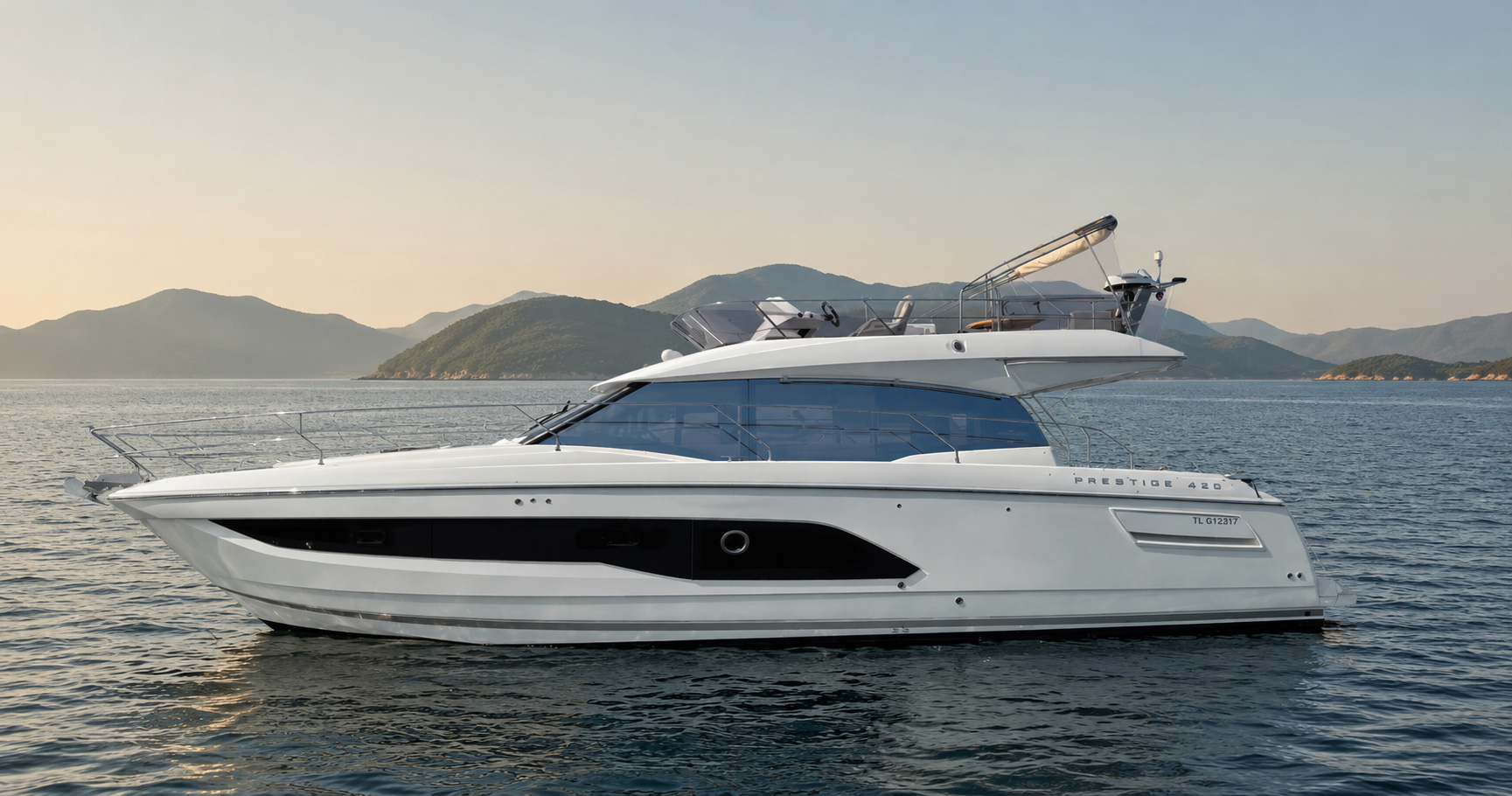
For a Prestige 420 berthed and operated in Hong Kong, our modelled annual running cost sits in roughly that range, led by berthing and maintenance. It is one of the most accessible entry points into serious flybridge ownership here — which is exactly why its running cost deserves a sober look before you commit.
The Prestige 420 sits almost exactly where most first-time Hong Kong buyers start looking: a ~42ft flybridge cruiser in the HK$3M–5M band, big enough for a family day out to Sai Kung or Lamma with guests aboard, small enough that one confident owner can genuinely run it without crew. It is among the more frequently listed models in this segment, which makes it a useful benchmark for anyone pricing their first serious boat.
This is a buyer-side read. We don’t sell boats and we don’t take a listing fee, so there’s no reason to make the number look smaller than it is. Below is what the Prestige 420 actually asks for in Hong Kong, where that asking price tends to sit versus the market, and the modelled annual cost of keeping one.
Across current Hong Kong listings, Prestige 420 examples are typically asking in the region of HK$2.8M–5.0M, depending on year, engine hours, drive package and refit history. But the asking price is a starting position, not the market.
From observed listing behaviour — how long these sit, and how asking prices move while they’re listed — our modelled asking-to-likely-transacted gap for this segment runs around 6–15%. The entry band is the most liquid part of the Hong Kong market, so well-priced boats move faster and carry less room; a boat that has sat for months, or that has already taken a public price cut, sits at the wider end of that gap. That spread is your negotiating room, and it’s invisible if you only look at the headline number on the listing page.
What “modelled” means here. We don’t hold a private database of confirmed sold prices — almost nobody credibly does for Hong Kong. Instead we model an indicative range from public listing behaviour: asking prices, days on market, price reductions, and the same vessel appearing across platforms. It’s an estimate, clearly labelled — and a dated, sourced estimate is more useful than a confident-sounding number nobody can show you the workings for.
This is the question that should come before price, and the one brokers tend to skip. The good news is that at ~42ft, the Prestige 420 sits below the most congested band of Hong Kong’s berthing market — options at this length are meaningfully wider than for a 50ft-plus boat, and a swing mooring is a genuinely workable fallback in a way it often isn’t for larger hulls. The bad news is that “wider” is relative: marina berths still carry waitlists, and the best locations still command a premium.
Before you fall for a specific hull, confirm you have a realistic berthing path — a marina berth, a private arrangement, or a swing mooring with the trade-offs that implies. We cover the current picture in our Hong Kong berthing & mooring blueprint.
Here’s the part that decides whether ownership is comfortable or stressful. The figures below are modelled ranges for a Prestige 420 kept and used in Hong Kong — treat them as a planning baseline, not a quote.
The Prestige 420’s pod-drive package with joystick docking is the single biggest reason it appeals to first-time Hong Kong owners: berthing a 42-footer stern-to in a crosswind stops being the terrifying part of ownership. In cost terms, that matters because it makes the no-full-time-crew model realistic — a part-time boat boy for washing, checks and basic upkeep, with the owner doing the driving. Our modelled range reflects that arrangement. The trade-off to know about: pod drives concentrate maintenance into scheduled service intervals that are not optional, and skipping them is the classic false economy on this boat.
Even at 42ft, a flybridge motor yacht in Hong Kong’s hot, humid, salt-heavy environment is maintenance-hungry. Antifouling, drive servicing, electronics, upholstery, air-conditioning, and the slow war against humidity all add up. A useful modelled rule of thumb is that annual maintenance lands around a meaningful percentage of the boat’s value — which is why a cheaper, older Prestige 420 is not always the cheaper boat to own.
A yacht is a depreciating asset — this is not the place for “investment” language. What matters for a Prestige 420 buyer is liquidity: how quickly and cleanly you can exit. The entry band works in your favour here — it is the most actively traded segment in Hong Kong, because there is always a new cohort of first-time buyers arriving at this price point. Prestige carries less brand weight in resale than Princess, so condition and service records do more of the talking: a boat bought well (at the right point in that asking-to-transacted gap), with its drive-service history complete and the interior kept dry, is far easier to move on than one bought at full asking and neglected. Your entry discipline is your exit strategy.
None of this is a reason not to buy — it’s the reason to buy with your eyes open. A Prestige 420 bought at the right number, with a berth secured, the service history verified and the running cost planned for, is one of the most sensible first serious boats in Hong Kong. The mistake is treating the purchase price as the cost.
Our modelled annual running cost is roughly HK$460,000–850,000, on top of the purchase price. Berthing and maintenance are the largest components. These are estimates modelled from public listing behaviour and typical Hong Kong market ranges, not verified figures — confirm against live quotes before committing.
Current listings typically ask in the region of HK$2.8M–5.0M depending on year, hours, drive package and condition. Asking is a starting position — our modelled asking-to-likely-transacted gap for this segment is around 6–15%, wider on long-listed or already-reduced boats.
Yes — this is one of the model’s core appeals. The pod-drive and joystick-docking package makes owner operation realistic for a confident first-time owner, with a part-time boat boy handling washing and basic upkeep. Our modelled cost reflects that arrangement.
Easier than for a 50ft-plus boat, but still not trivial. Marina berths at this length carry waitlists, and a swing mooring is a workable fallback with trade-offs. Secure a realistic berthing path before committing to a specific hull.
No — like all yachts it depreciates. The useful question is liquidity, and the entry band is the most actively traded segment in Hong Kong. A well-bought, well-documented boat with complete drive-service records is far easier to resell. Treat it as a depreciating asset, not an investment.
Comparing models? See modelled running costs for every popular yacht in our Hong Kong yacht ownership cost guide.
Our read on the policies, berthing shifts, and price moves that change yacht-buying decisions in Hong Kong — estimated market values, op-ex benchmarks, and the analysis behind them. No spam. No sales pitch. Unsubscribe anytime.