AI Valuation Audit - The Concierge Protocol
Buying a yacht in Hong Kong is a process of clearing friction layers. We are a buyer-side intelligence unit. We don’t represent sellers. We represent the math.


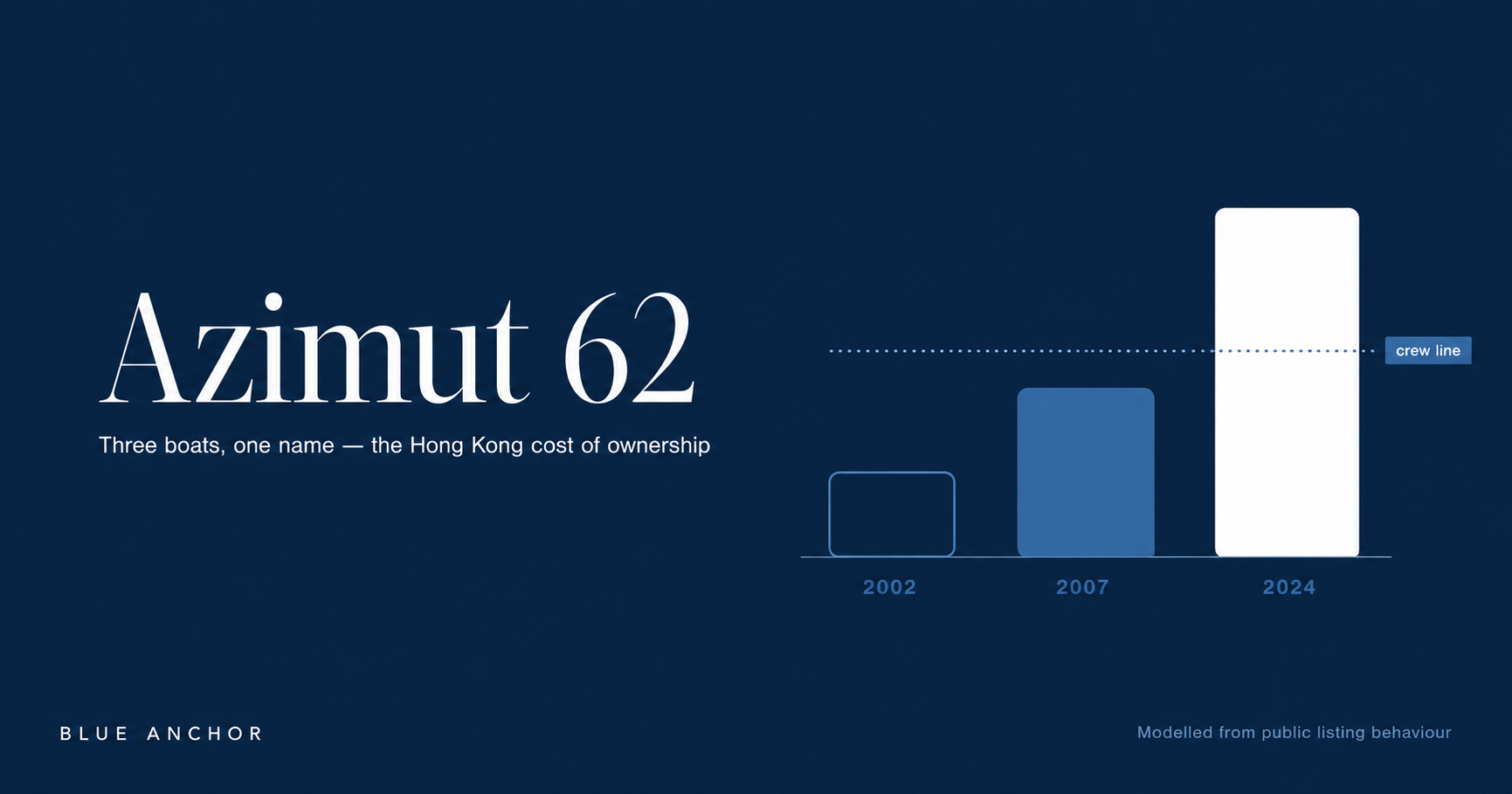
Three structurally different boats share the name "Azimut 62" — the 2002 Flybridge, the 62E, and the 2024 Fly 62. Modelled annual running cost in Hong Kong is roughly HK$920,000–1.7M, and 62ft is where full-time crew stops being optional. A buyer-side read on the generation trap, the crew threshold, and when not to buy.
Before any of that: three genuinely different boats are sold in Hong Kong under the name “Azimut 62” — the 2002 Flybridge, the 62E that replaced it, and the Fly 62 launched in 2024. They are separated by more than twenty years and by a very wide price gap. Knowing which one you’re looking at is the first piece of negotiating leverage, and most listings won’t tell you plainly.
The Azimut 62 is where Hong Kong buyers tend to arrive after outgrowing a 50-footer: still recognisably a private boat rather than a small ship, but with the volume, the Italian styling and the guest capacity that a 52 can’t quite deliver. It is also the point at which the economics change character — not gradually, but at a step.
This is a buyer-side read. We don’t sell boats, hold no listings and take no seller fees, so there’s no reason to make the number look smaller than it is. Below: which Azimut 62 you’re actually being shown, what each generation asks in Hong Kong, the modelled cost of running one, and the crew threshold that decides whether this size is comfortable or punishing.
This matters more than anything else on the page. Select a generation.
This is the cheapest route to 62 feet in Hong Kong and, handled correctly, a rational one — the volume, beam and flybridge of a boat that would cost several times more new. Handled carelessly, it is the most expensive mistake on this page.
For most Hong Kong buyers in this segment, the 62E is the sensible centre of gravity: enough distance from the 2002 original to have meaningfully newer systems, enough depreciation absorbed by earlier owners to make the entry price rational.
A different purchase from the other two in every respect, including price band. If you are comparing a Fly 62 against a 62E, you are not comparing two versions of the same boat — you are comparing two different budgets that happen to share a number.
This is the structural fact that separates a 62 from the 52 you may be stepping up from. Below roughly 55 feet, a confident owner can realistically run the boat with a part-time boat boy. Above it, most Hong Kong owners end up with full-time crew — not because a rule requires it, but because docking, systems, guest handling and maintenance coordination stop fitting into a weekend.
The financial consequence is a step, not a slope. Adding one full-time crew member introduces a recurring cost that does not scale down in the months you don’t use the boat, and it is the single largest reason a 62 costs materially more to hold than a 52 — more than berth, more than fuel.
The figures below are modelled ranges for an Azimut 62 kept and used in Hong Kong, assuming one full-time crew member. Treat them as a planning baseline, not a quote.
A 62-footer on large-displacement diesels drinks properly when pushed, but Hong Kong usage patterns keep the number in check: short runs to Sai Kung or the southern islands, long periods at anchor, and most owners cruising well below maximum. The line that actually surprises people is maintenance. At this size, everything is bigger and more of it: two large engines, a generator that runs constantly for air-conditioning, more systems, more surface area fighting humidity and salt. On an older hull, budget the upper end and be pleased if you’re wrong.
62ft sits above the most comfortable band of Hong Kong’s berth market. Options narrow, the premium rises, and a swing mooring — a genuinely workable fallback at 42ft — becomes a much harder proposition for a boat of this volume and value. Confirm a realistic berthing path before you fall for a specific hull. Our berthing blueprint maps every route, including the private secondary market where most owners at this size actually land.
From observed listing behaviour — days on market, price movement while listed, and the same hulls reappearing across platforms — our modelled asking-to-likely-transacted gap for the 62ft segment runs around 10–20%, wider than the entry band. Two reasons. The buyer pool thins sharply above 55 feet, because the running cost filters people out faster than the purchase price does. And the generation confusion described above means some boats sit mispriced for months simply because the market can’t tell at a glance what it’s looking at.
That spread is your negotiating room. It widens further on a hull that has been listed for a long time, has taken a public price cut, or belongs to an owner who has already bought the next boat.
A yacht is a depreciating asset, and this page will not pretend otherwise. What matters at 62 feet is liquidity, and the honest position is that it is thinner here than at 52. Your buyer must be someone who can carry HK$920k–1.7M a year comfortably — a materially smaller group than the one buying at entry level.
Three things improve your exit measurably: buying at the right point in that 10–20% gap in the first place, a complete and continuous service file, and a berth arrangement that can transfer with the boat. In this market that last one is worth more than most people realise — a 62 with a genuinely transferable berth solves the next buyer’s hardest problem, and prices accordingly.
None of this argues against buying one. An Azimut 62 bought at the right point in the gap, with the generation correctly identified, a berth secured, the service history verified and the crew cost planned for, is one of the better-value routes to genuine 60-foot volume in Hong Kong. The mistake is treating the purchase price as the cost, and treating “Azimut 62” as if it described one boat.
Our modelled annual running cost is roughly HK$920,000–1,700,000, on top of the purchase price, assuming one full-time crew member. Berthing and crew are the largest components. These are estimates modelled from public listing behaviour and typical Hong Kong conditions, not verified figures — confirm against live quotes before committing.
It depends entirely on generation. Observed regional listings translate to roughly HK$3.0M–5.0M for the 2002-generation 62 Flybridge, HK$3.0M–6.0M for the 62E, and around HK$7.0M–8.0M for early pre-owned Fly 62 examples, with new-build Fly 62 listings in the region far higher at roughly HK$23M and above. Asking is a starting position — our modelled asking-to-likely-transacted gap in this segment is around 10–20%.
They are three different boats sharing a number. The 62 Flybridge arrived in 2002 with Stefano Righini exterior design and was built on the success of the Azimut 55. The 62E succeeded it in 2007. The Fly 62 is a current-generation model launched at the 2024 Cannes Yachting Festival, designed with Alberto Mancini — a complete redesign rather than an update. Establish which one a listing refers to before discussing price.
No rule requires it, but most Hong Kong owners at this size end up with full-time crew. Around 55 feet is where docking, systems management, guest handling and maintenance coordination stop fitting comfortably into an owner’s weekend. Our modelled cost assumes one full-time crew member, which is the single largest reason a 62 costs materially more to hold than a 52.
Yes. 62ft sits above the most comfortable band of the berth market — options narrow, the premium rises, and a swing mooring is a much harder proposition than at 42ft. Secure a realistic berthing path before committing to a specific hull.
No — like all yachts it depreciates. The useful question at this size is liquidity, and it is thinner than at entry level because the buyer pool is filtered by running cost rather than purchase price. A well-bought boat with a complete service file and a transferable berth is materially easier to resell.
Comparing sizes? See modelled running costs for every popular model in our Hong Kong yacht ownership cost guide.
Our read on the policies, berthing shifts, and price moves that change yacht-buying decisions in Hong Kong — estimated market values, op-ex benchmarks, and the analysis behind them. No spam. No sales pitch. Unsubscribe anytime.