AI Valuation Audit - The Concierge Protocol
Buying a yacht in Hong Kong is a process of clearing friction layers. We are a buyer-side intelligence unit. We don’t represent sellers. We represent the math.


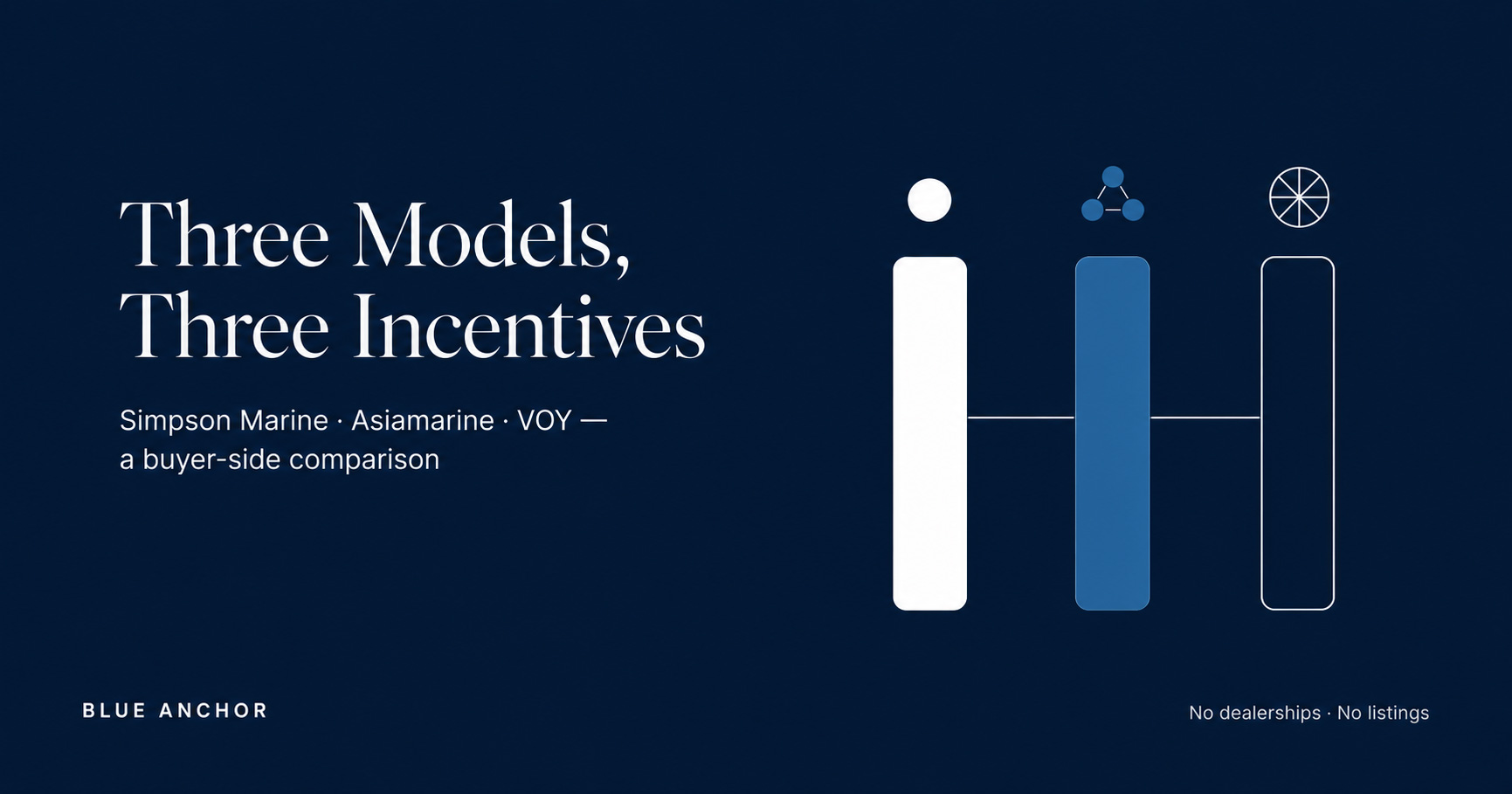
Simpson Marine, Asiamarine and VOY are three genuinely different businesses — a builder-owned dealership, an independent multi-brand group, and a fractional-ownership platform. The structural difference determines what advice you get. An independent buyer-side read on who each represents, how each is paid, and the questions to ask before you commit.
Simpson Marine is a dealership owned since 2024 by one of the builders it represents. Asiamarine is an independent multi-brand group spanning dealership, brokerage, charter and management. VOY is a fractional-ownership and management platform selling shares in boats rather than boats. None of that makes any of them wrong for you — but each answers “which boat should I buy?” from a different place, and knowing where is the whole point of this page.
Our own disclosure, before anything else. Blue Anchor holds no dealership, no listings and no inventory. We charge buyers nothing. We earn co-introduction fees from brokers and commissions from vendors on completed transactions — which means we have an interest in you eventually transacting with someone, and no interest in which of these firms it is. We have no commercial arrangement with any of the three companies on this page. Read everything below in that light.
Ask any Hong Kong buyer who they’ve spoken to and the same names come back: Simpson Marine, Asiamarine, VOY. They get grouped together as “the yacht companies,” which obscures the single most useful thing about them — they are not the same kind of business at all. One sells new boats for the builders it represents. One does a bit of everything across many brands. One sells you a tenth of a boat and manages it.
That structural difference is not a detail. It determines which boats get recommended to you, what happens after the sale, and where the incentives sit when you ask a question the answer to which might cost the firm money. Here is the map.
This is our qualitative read, not a score anyone publishes. It answers one question: when you ask “is this the right boat for me?”, how free is the person answering to say no?
Read this correctly. A position on the right is not a mark against the firm — it is simply what a dealership is. A car dealer isn’t dishonest for recommending the cars it sells; it would be strange if it didn’t. The mistake buyers make is treating a dealer’s recommendation as independent advice. It is a sales recommendation from a well-informed party, which is a genuinely useful thing — just not the same thing.
The single most important change in the Hong Kong market in recent years got almost no buyer-side commentary: in 2024, Sanlorenzo Group acquired Simpson Marine, taking ownership from founder Mike Simpson. Both companies have described this publicly as preserving heritage while enabling regional expansion, and there is no reason to doubt the operational logic — Simpson had represented Sanlorenzo for years and the two were already deeply aligned.
But look at it from a buyer’s chair. Asia’s largest dealership, which also runs a substantial brokerage and represents multiple competing brands, is now owned by one of those brands’ builders. If you walk in undecided between a Sanlorenzo and a comparable Italian or British competitor, the person advising you works for a company owned by one of the candidates. That is not a scandal and it is not hidden — it is on their own website. It is simply a fact you should hold while listening.
What we are not saying. We are not suggesting Simpson Marine’s brokers give bad advice, mis-sell, or fail their clients. By every public account they are the most experienced yacht sales organisation in Asia, and experience has real value. We are saying only this: know who owns the company advising you, and weight the advice accordingly — exactly as you would with any dealer in any industry.
| Simpson Marine | Asiamarine | VOY | |
|---|---|---|---|
| Business type | Dealership + brokerage, builder-owned | Independent multi-brand dealer, broker, charter, management | Fractional ownership + management platform |
| Established | 1984 (HK) | Group formed 2013 (HK) | Hong Kong |
| Owned by | Sanlorenzo Group (since 2024) | Independent, founder-led | Independent platform operator |
| You buy | A whole boat, usually new | A whole boat, new or brokerage | A share of a boat (10%–100%) |
| Best fit | Committed to a represented brand; wants the deepest new-build and aftersales network in Asia | Wants brand choice, a service department, and superyacht access via Fraser | Wants occasional use at low entry cost and no operational involvement |
| Main watch-out | Parent company builds boats you may be choosing between | Still a dealer — brand recommendations follow the shelf they carry | Return and buyback promises are contractual, not asset-backed — read them closely |
| Berth help | Established network, no guarantees | Established network, no guarantees | Berth usually bundled into the programme — confirm what happens if you exit |
| After the sale | Regional service and management infrastructure | In-house aftersales and technical team | Management is the core product, not an add-on |
Company facts are drawn from each firm’s own published material and named press reporting (see source note). “Best fit” and “main watch-out” are Blue Anchor’s buyer-side interpretation.
VOY’s model deserves its own section because it is the one most often misunderstood — in both directions.
The genuine appeal is real. Hong Kong is an occasional-use boating market: most owners use their boat far less than they imagined they would, while paying for it every single day. A structure that matches cost to actual usage is a rational response to that, not a gimmick. For a buyer who wants twenty days on the water a year and has no interest in managing anything, a share can be the honest answer where a whole boat is not.
The part that needs care is the return language. VOY’s own site describes the programme as offering a fixed annual return of at least 10%, guaranteed for up to five years. Any buyer should hold that claim up to one simple test: a yacht is a depreciating asset, so a promised return is not coming from the asset — it is a contractual promise from the operator. That may be perfectly sound. But it means your questions are corporate-credit questions, not boat questions: who exactly is the counterparty, what is the promise backed by, what happens if charter revenue underperforms, how is the buyback price calculated, and is your share equity in the vessel or a contractual right against a company?
The wider context, fairly stated. Fractional yachting has attracted broad criticism as a category — a 2024 Hong Kong commentary in Dim Sum Daily argued that fractional schemes here often deliver less than promised, with scheduling friction and ancillary charges eroding the value. Set against that, Asiamarine’s founder has publicly reported a fractional programme running for years with participating owners and no date conflicts. Both accounts can be true: execution quality varies enormously between operators, which is precisely why the paperwork matters more here than in a conventional purchase.
Choose the description that matches you.
Go straight to whoever represents it. If it’s a Sanlorenzo, Bluegame, Fairline, Nautor Swan or Axopar, that’s Simpson Marine. If it’s a Galeon, Bali, Nimbus or Pardo, that’s Asiamarine. There is no advantage in a middleman when the brand decision is already made — you want the authorised dealer’s build slot, warranty and service network.
The buyer-side work here is not who but what you sign: delivery timeline and penalties, specification list in writing, warranty terms and who honours them locally, and — critically in Hong Kong — whether any berthing assistance mentioned in conversation exists anywhere in the contract.
Both Simpson Marine and Asiamarine run brokerage alongside their dealerships, so both can show you boats they don’t represent. That is genuinely useful. The thing to hold in mind is that a brokerage sitting inside a dealership has a soft gravitational pull toward the new-boat shelf, and toward listings the house itself holds.
Practical approach: talk to both, look at listings from each, and value the boat independently of whoever is showing it to you. Our used-yacht buyer checklist covers survey, title and berth-transfer verification — the parts of a used purchase where deals are actually won or lost.
This is the profile fractional exists for, and dismissing it outright would be dishonest. VOY’s structure, and Asiamarine’s programme, both address a real Hong Kong problem: paying 365 days for 20 days of use.
Before committing, get written answers on: what your share legally is (vessel equity or a contract right), how usage days are allocated in peak season, every charge outside the headline share price, what the berth arrangement is and whether it survives your exit, how the buyback price is set and who funds it, and what happens if the operator ceases trading. If any answer arrives verbally rather than in the agreement, treat it as not existing.
This is the case where walking into a dealership first works against you. Not because anyone will mislead you, but because every one of these firms is structurally equipped to answer “which of ours?” and none of them is structurally equipped to answer “should you at all?”
Settle three things first, in this order: the annual running cost you’re actually comfortable with, a realistic berthing path, and the usage pattern you’ll genuinely have. Then the choice between these three firms mostly makes itself — and you’ll walk in with a specification instead of a wish.
Same questions, all three firms. The answers tell you more than any brochure.
These three dominate the conversation but they aren’t the whole market. Asia Yachting, founded in 2007, represents Prestige, Monte Carlo Yachts and Fountaine Pajot among others — relevant if you’re looking at the entry flybridge segment, where our Prestige 420 cost analysis sits. Northrop & Johnson and other international brokerages operate here at the superyacht end. And a substantial share of Hong Kong’s used market moves privately, never touching a dealer’s listings at all.
Simpson Marine is the deepest new-boat organisation in Asia and, since 2024, is owned by Sanlorenzo — excellent if you want a brand it represents, worth holding in mind if you’re weighing that brand against a rival. Asiamarine is independent with a wider shelf, real service depth and Fraser access at the top end — still a dealer, still pointed at its own brands. VOY sells shares rather than boats, which genuinely fits occasional users, and its return and buyback promises are contractual questions rather than boat questions. None of them is the wrong answer. The wrong move is walking into any of them before you’ve settled your running-cost tolerance, your berth path and your real usage — because all three are built to answer “which of ours?”, and none is built to answer “should you at all?”
Before you take any meeting, know your numbers: see modelled annual running costs for every popular model in our Hong Kong yacht ownership cost guide.
Sanlorenzo Group acquired Simpson Marine in 2024, taking ownership from founder Mike Simpson, who retired. Both companies have publicly described the deal as preserving the company’s heritage while supporting regional expansion. For buyers, the relevant point is that Asia’s largest dealership is now owned by one of the builders it represents.
Neither is better in the abstract — they carry different brands. If you want a Sanlorenzo, Bluegame, Fairline, Nautor Swan or Axopar, Simpson Marine is the authorised route. If you want a Galeon, Bali, Nimbus or Pardo, or superyacht access via Fraser, Asiamarine is. Both also operate brokerage, so both can show you used boats outside their own brands.
It depends entirely on your usage pattern and on the contract. For someone wanting roughly twenty days a year with no operational involvement, a share can be more rational than a whole boat. VOY’s site describes a fixed annual return of at least 10% guaranteed for up to five years — because a yacht is a depreciating asset, any such return is a contractual promise from the operator rather than something the asset generates. Get the counterparty, the backing, the buyback mechanics and the exit terms in writing before committing.
Structurally, no. Dealerships represent the brands they carry; brokerages within them typically act for the seller or for the house; programme operators represent their programme. That is normal in the industry worldwide. It is also why an independent buyer-side layer exists — to hold the questions no one at the table is incentivised to raise.
All three have networks and none can guarantee a berth — Hong Kong has roughly 12,300 licensed vessels competing for about 4,300 berths and moorings. Treat any berthing assurance as real only if it appears in the contract. Our berthing blueprint maps every realistic path, including the private secondary market where most new owners actually land.
No. We hold no dealership, no listings and no inventory, and we have no commercial arrangement with Simpson Marine, Asiamarine or VOY. We charge buyers nothing and earn co-introduction fees from brokers and vendors on completed transactions, which we disclose openly. We have an interest in buyers eventually transacting — and no interest in with whom.
Sources: Simpson Marine corporate website and news releases, simpsonmarine.com (Sanlorenzo Group acquisition 2024; brand representation; company history, accessed July 2026); Yacht Style, “Simpson Marine embarks on new journey” (2024); Asiamarine corporate website and LinkedIn company page, asiamarine.com (group formation, brand portfolio, Fraser representation, office network, accessed July 2026); Asia Yacht Press interview with Eric Noyel on Asiamarine’s fractional programme; VOY corporate website, voy.hk (fractional share structure, usage days, stated return and buyback mechanism, accessed July 2026); Dim Sum Daily, commentary on fractional yacht ownership in Hong Kong (10 January 2024); Asia Yachting corporate website, asiayachting.net (accessed July 2026). Company descriptions reflect each firm’s own published statements. Berth and vessel counts are Hong Kong market figures previously cited in our berthing analysis. All interpretation, positioning and the incentive read are Blue Anchor’s own and are qualitative, not quantitative measures.
This article is general information for yacht buyers and owners and not regulatory, tax, legal or financial advice. It is not an allegation of wrongdoing by any company named, and it is not a recommendation to transact with or avoid any of them.
Our read on the policies, berthing shifts, and price moves that change yacht-buying decisions in Hong Kong — estimated market values, op-ex benchmarks, and the analysis behind them. No spam. No sales pitch. Unsubscribe anytime.