AI Valuation Audit - The Concierge Protocol
Buying a yacht in Hong Kong is a process of clearing friction layers. We are a buyer-side intelligence unit. We don’t represent sellers. We represent the math.


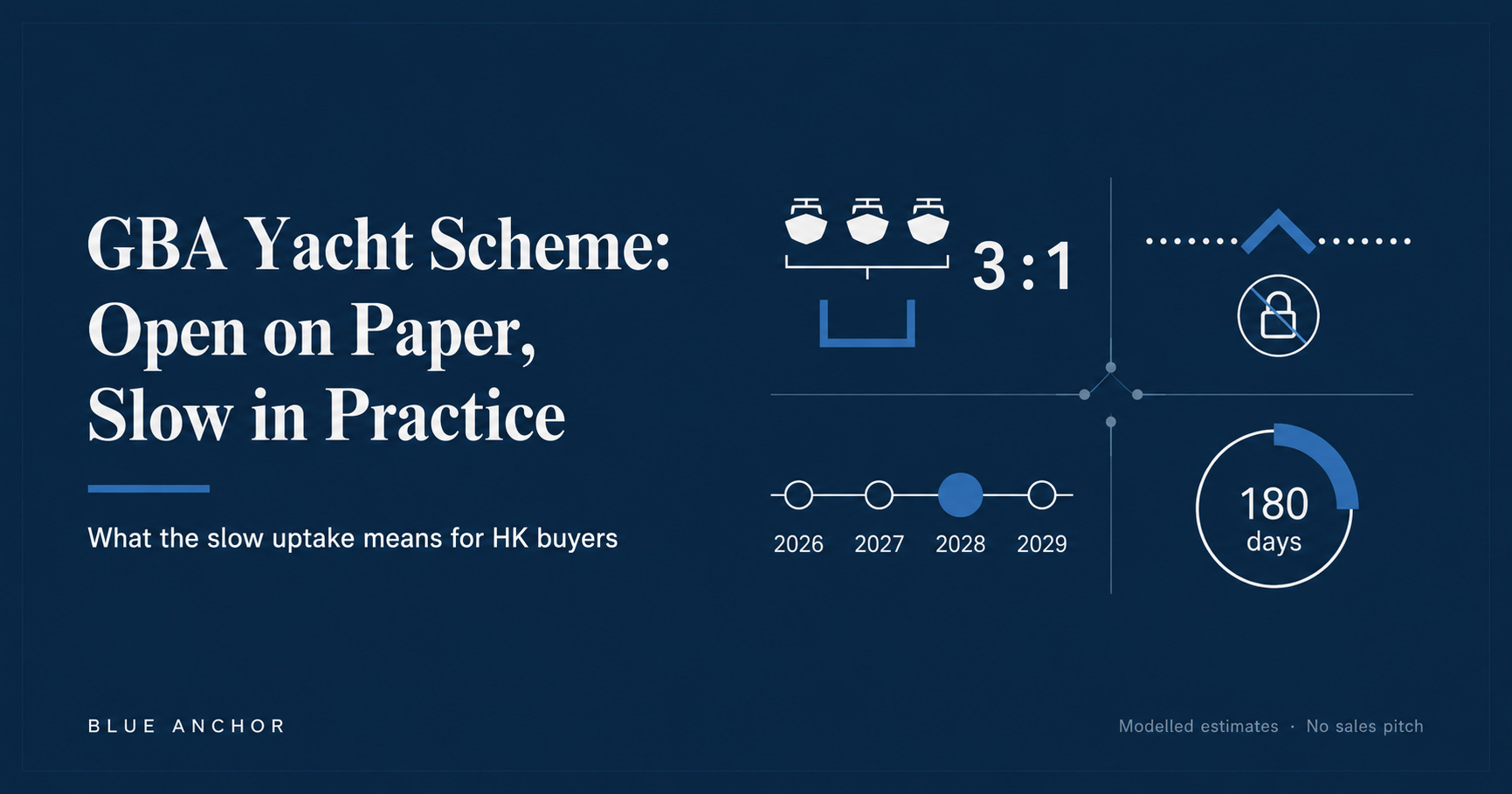
The GBA individual yacht travel scheme launched in June 2026 removes significant financial barriers, but eligibility restrictions, a berth shortage, and infrastructure timelines temper the near-term picture for most HK buyers.
The State Council’s 31 May 2026 directive scrapped the financial customs guarantee and introduced temporary ship nationality registration, making cross-border passages to nine mainland cities operationally possible. What it does not fix is an eligibility ceiling for expatriate owners, a berth-to-vessel ratio still roughly one-to-three, and a wave of new marina supply that remains firmly on the drawing board. For a buyer weighing a HK$3M–10M purchase today, the scheme changes the headline story but not the underlying cost structure.
Blue Anchor · Yacht ownership desk · 2026-07-30
On 30 May 2026, the State Council issued a directive taking effect immediately that gave Hong Kong- and Macau-registered yachts the right to enter nine designated mainland cities in the Greater Bay Area without posting a customs guarantee and without permanently re-flagging the vessel, confirmed the HKSAR Government the same day. The first vessels to operate under the new framework were part of a Royal Hong Kong Yacht Club flotilla — ten boats in total, organised in collaboration with the Zhuhai Yacht Association — that made a weekend passage to Guishan Island, as reported by the South China Morning Post on 30 July 2026. Their voyage validated the policy in practice. The bigger question is what it actually means for the owner considering a purchase in 2026.
The face-value read is seductive: a dormant “yacht economy” has been unlocked overnight, offering HK owners access to hundreds of kilometres of Guangdong coastline that were previously gatekept by punishing financial requirements. The honest framing is narrower. Eligibility rules exclude a significant segment of today’s ownership base, the berthing infrastructure needed to handle increased cross-border traffic is years from completion, and the government’s own advisers were reluctant to put firm numbers on economic impact as recently as September 2025. The policy is meaningful — but buyers who price its full promise into a purchase decision today are running ahead of the evidence.
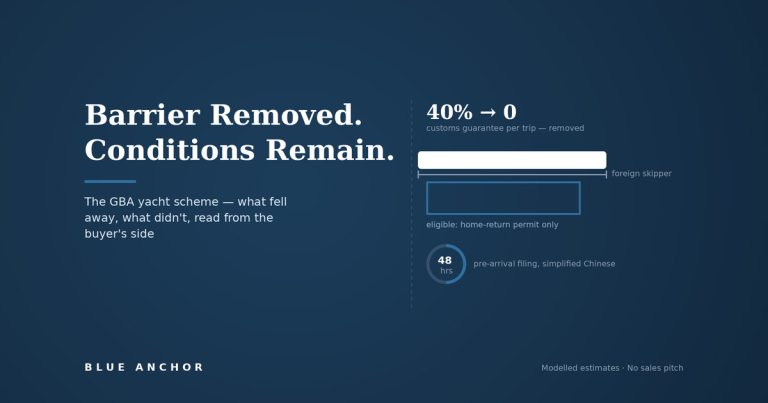
China’s State Council removed two of the most burdensome barriers that had long discouraged Hong Kong-registered yachts from sailing to nearby mainland cities: the obligation to post a sizeable customs guarantee before each crossing, and the requirement to re-flag the vessel on the mainland. Under the new arrangement, yachts with local Hong Kong licences can obtain a temporary mainland vessel nationality certificate that allows them to operate multiple times in designated GBA areas for up to 180 days.
Until the directive, yacht owners had to post a bank guarantee or surety bond — even for a weekend cruise — with industry insiders estimating the upfront cost could reach HK$500,000 for a 60-foot boat, pricing out most leisure operators and corporate charter firms. That structural cost is now gone for qualifying owners.
What the directive did not change: the requirement to clear designated ports, the obligation for all persons aboard to carry valid travel documentation, and the underlying eligibility rules on who can captain a qualifying passage.
Lazy framing vs honest framing. Headlines declared Hong Kong had “joined the global yachting revolution.” The honest framing is that a specific financial friction — the pre-trip customs guarantee — has been removed. Clearing in and out of designated mainland ports, carrying compliant vessel documentation, and satisfying crew eligibility requirements remain part of every northbound passage. This is a meaningful cost reduction, not a paperwork-free border.
A Guangdong provincial government planning document seen by the SCMP showed that the proposed guidelines limited applicants strictly to Hong Kong and Macau residents holding mainland travel permits in the initial stage, explicitly excluding foreigners who hold home-return permits — while also providing for a 180-day temporary mainland vessel nationality certificate for vessels with Hong Kong licences.
Applicants in the initial stage would be limited to Hong Kong and Macau residents with mainland travel permits, though Lee Shu-kam of Hong Kong Shue Yan University’s economics and finance department suggested a controlled pilot scheme could set the stage for easing regulations for international participants. That broader opening has not yet been formalised.
This matters directly to buyers in the HK$3M–10M segment. A meaningful proportion of boat owners — and prospective buyers — in Hong Kong are expatriate permanent residents who may not hold the relevant permit or who have only recently become eligible for the newer non-Chinese-citizen variant introduced in July 2024. For that cohort, the northbound route is technically open but requires a separate document-eligibility check before a first passage can be planned.
Buyer implication. If you are a non-Chinese permanent resident, confirm your Mainland Travel Permit status before factoring cross-border cruising into your ownership model. The scheme is a pilot — not a fully open framework — and eligibility rules may tighten or broaden as the scheme is reviewed.
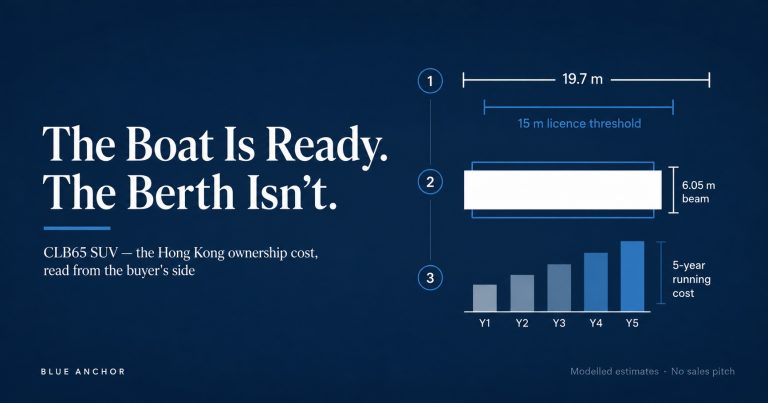
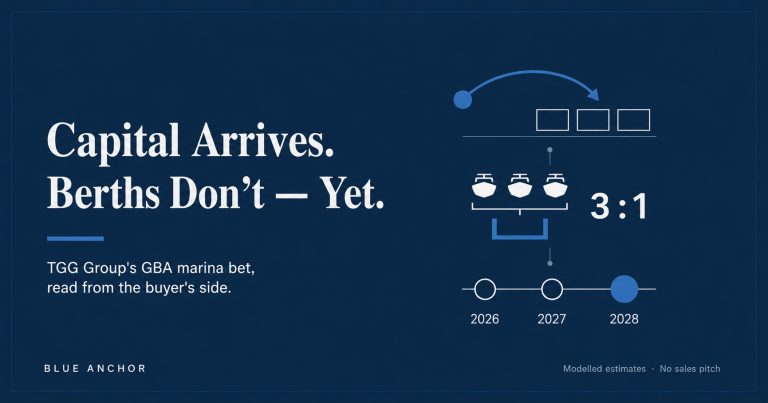
The most structurally important constraint on Hong Kong yacht ownership predates and outlasts the GBA scheme. The Airport Authority’s own projections describe a city where 12,500 licensed yachts compete for only 4,300 berths. That ratio — approximately three vessels per available space — has worsened steadily. Licensed vessel numbers in Hong Kong more than doubled between 2007 and 2024.
The GBA passage route is occasionally framed as a partial release valve for berthing pressure — the idea being that vessels away on northbound passages free up temporary space at home. In practice, the eligible universe for early-stage northbound trips is small, passages are weekend-length, and no structural supply relief results. A buyer who cannot secure a berth today will not find the situation meaningfully improved by the GBA scheme.
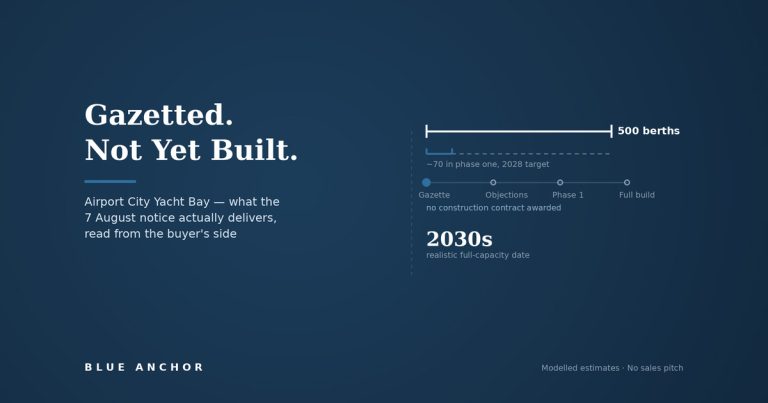
Honest framing on relief infrastructure. Government announcements reference more than HK$30 billion earmarked for new nautical facilities. The reality on delivery timelines is far more measured. The Airport Authority launched the Skytopia marina project — part of the broader Airport City plan — soliciting global partners, with the first phase scheduled for completion in 2028, initially accommodating 70 small and medium-sized vessels. A meaningful inventory of berths at that location follows later still.
The government’s plan for four new marinas — Skytopia, Hung Hom, Aberdeen, and Lamma Island — is intended to add approximately 1,200 berths in aggregate. The Aberdeen project is set to provide around 200 berths for boats up to 50 metres, plus affordable mooring spaces. The Lamma Island quarry site covers approximately 20 hectares and is expected to accommodate between 150 and 200 berths for yachts up to 50 metres. These are planning-stage figures. For the buyer transacting today, the operative reality is the existing 4,300 berths, not the projected 1,200 additions.
For a deeper read on the current and projected berthing landscape, including what to look for in a pre-purchase mooring assessment, see Blue Anchor’s 2026 Hong Kong Berthing Blueprint.
Early estimates forecast an annual intake for Hong Kong’s marine economy of around HK$4.5 billion, roughly half of Hong Kong Disneyland’s turnover last year. That figure circulates widely in government-aligned commentary and industry briefings. It is not, however, a number with a publicly disclosed methodology or an independent verification trail.
Secretary for Culture, Sports and Tourism Rosanna Law, speaking at the Policy Address press conference in September 2025, said it was too early to estimate the economic impact of the plan — even as she confirmed berth construction was underway at multiple sites. That honest qualifier from within government deserves more weight than it typically gets in the trade press.
Dennis Kwok of the Hong Kong Institute of Vocational Education noted on RTHK’s Backchat programme in June 2026 that the policy’s spillover effects extend to maintenance crews, guests, and business partners — all of whom generate economic activity in Hong Kong beyond the yacht owner alone. That is a legitimate indirect benefit. It accrues to the city broadly, not to individual vessel owners.
The policy framework is explicitly two-directional. Comprehensive efforts are underway to facilitate southbound travel for mainland yachts, potentially fostering a mutual yacht tourism market and positioning Hong Kong as a key regional hub for international vessels. As David Norton, vice commodore of the Royal Hong Kong Yacht Club, said on RTHK in June 2026, the policy is a significant boost for yacht races and sailing events and the industry is looking forward to more details becoming available.
For owners in the HK$5M–10M segment, a potential southbound flow of mainland vessels is relevant to the ancillary services market — bunkering, maintenance, provisioning, and charter crew. Lee Shu-kam at Hong Kong Shue Yan University suggested the pilot scheme could set the stage for international participation and drive demand for services including legal, financial, marine insurance, and yacht maintenance. These are real secondary benefits, though they are medium-term projections rather than current market realities.
The structural risk for buyers is the reverse: if southbound mainland vessels arrive in meaningful numbers but berthing capacity has not expanded proportionately, the existing supply squeeze gets worse before it gets better. Boat owners and maritime experts have been explicit that Hong Kong must seize the opportunity to upgrade marine infrastructure to attract mainland yachts — precisely because the current base is insufficient for the two-way ambition.
Verify your personal travel document eligibility before planning a northbound passage — specifically, confirm that all crew and guests aboard hold the relevant mainland travel permit. Authorities are working to simplify administrative processes and enhance digital systems to support smoother yacht entry and departure procedures , but until a standardised owner handbook is published, the prudent move is to plan your first northbound passage through an organised club flotilla rather than independently. Review your marine insurance policy with your broker to confirm coverage under temporary mainland nationality registration — this is a genuinely new regulatory status that your policy may not yet explicitly address.
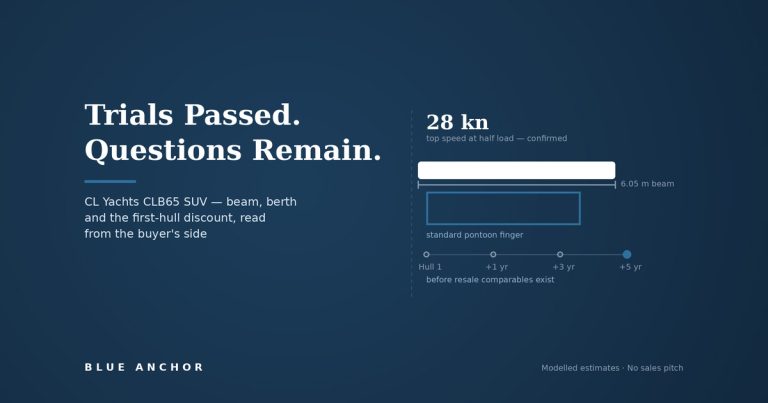
The GBA scheme changes the narrative around cross-border cruising but does not change the fundamentals of the purchase decision. Berth security is still the single variable most likely to affect both your ownership experience and your eventual exit. A vessel that comes with a secured berth solves the next buyer’s biggest problem and makes it far easier to resell. Budget northbound passage costs as a modest recurring expense — fuel, port fees, and any required documentation — rather than a transformative operating cost reduction. The customs guarantee cost that has been removed was a barrier to entry, not a routine running cost most owners absorbed.
On the macro picture: plans to add over 1,100 new berths and expand key sites such as the Aberdeen typhoon shelter and the former Lamma quarry show real policy action , but the timeline from planning to berth allocation runs well past 2026. Price your purchase on today’s supply reality. Use Blue Anchor’s ownership cost hub to stress-test annual running costs before you commit.
The State Council’s 31 May 2026 directive is a genuine policy milestone: it removes the customs guarantee burden — potentially worth hundreds of thousands of Hong Kong dollars for a mid-size vessel — and grants qualifying Hong Kong-registered yachts a 180-day temporary mainland nationality certificate. The first organised passages under the scheme have been completed successfully. However, the eligibility gate currently filters out expatriate permanent residents without the relevant mainland travel permit, no standardised independent passage handbook exists yet, and the marine insurance treatment of the new temporary flag status needs individual policy verification. On infrastructure, over 1,200 new berths are planned across four sites, but meaningful delivery does not begin until 2028 and the current three-to-one vessel-to-berth ratio will persist through the near term. Buyers should treat the scheme as a positive directional signal that expands the operating territory of a future purchase — not as a feature that rewrites the core cost and berthing calculus of ownership today.
For a full breakdown of projected marina supply, typhoon shelter mooring options, and what new berth supply timelines mean for buyers transacting now, see Blue Anchor’s 2026 Hong Kong Berthing Blueprint.
Not immediately and not universally. The initial pilot restricts participation to Hong Kong and Macau residents holding a Mainland Travel Permit. Foreign nationals who are Hong Kong permanent residents but do not yet hold the newer non-Chinese-citizen variant of the permit may face additional steps. Verify your document status before planning a northbound passage, and consider joining a club-organised flotilla for a first trip rather than going independently.
The biggest change is the abolition of the customs guarantee — a surety bond that industry insiders estimated could reach HK$500,000 for a 60-foot yacht — and the introduction of a temporary ship nationality registration valid for up to 180 days and multiple entries across nine designated mainland cities. Standard customs clearance procedures at designated ports still apply, as does the requirement for all persons aboard to carry valid travel documentation.
Not in the near term. The Skytopia first phase is scheduled for staged completion from 2028 and initially accommodates only 70 small and medium-sized vessels before reaching its full 500-berth capacity. Aberdeen and Lamma expansions are at earlier planning stages. With roughly 12,500 licensed yachts competing for around 4,300 berths, the supply imbalance is unlikely to ease meaningfully before 2028 at the earliest — meaning berth security at point of purchase remains a critical buying criterion.
Under the new temporary ship nationality registration provision, your Hong Kong registration is preserved. The scheme grants a temporary mainland nationality certificate for use within designated GBA waters, valid for multiple entries across a 180-day window, without requiring you to re-flag the vessel. That said, the insurance implications of operating under this temporary status should be confirmed with your marine insurer before a first passage.
The supply-demand imbalance means that securing a berth commitment before or at the point of purchase remains as critical as ever. Vessels that already come with a confirmed berth assignment solve the next buyer’s biggest practical problem and are meaningfully easier to exit when the time comes. Budget reality: expect HK$30,000–HK$80,000-plus annually in marina fees depending on vessel size and club membership, before any cross-border passage costs are factored in.
Treat it as a headline planning figure, not a committed revenue projection. Secretary for Culture, Sports and Tourism Rosanna Law said at the October 2025 Policy Address press conference that it was too early to estimate the economic impact of the plan. The HK$4.5 billion estimate appears in early government-aligned projections without a disclosed independent methodology. It reflects genuine policy ambition, but no buyer or owner should make a financial decision on the back of an unverified forecast of sector-level revenue.
Sources: South China Morning Post, “New yacht travel scheme makes waves but can Hong Kong cash in on marine economy?” (30 July 2026); South China Morning Post, “Travel scheme could allow Hong Kong, Macau yachts to sail to 6 Greater Bay Area ports” (23 April 2026); South China Morning Post editorial, “Cross-border scheme could boost Hong Kong’s yacht economy dreams” (4 May 2026); South China Morning Post, “Hong Kong launches Skytopia marina project to drive tourism and yacht economy” (20 April 2026); Hong Kong Free Press, “Beijing grants freer access to Hong Kong and Macau yachts in Greater Bay Area” (1 June 2026); RTHK, “Yacht tourism boom on horizon as sailing curbs eased” (2 June 2026); RTHK, “‘Yacht economy will attract luxury tourists'” (21 September 2025); news.gov.hk, “GBA open to HK, Macau yachts” (30 May 2026); The Standard, “Multi-destination GBA yacht scheme will draw visitors to HK, lawmaker says” (27 May 2026); Macao News, “The GBA’s yacht ambitions go beyond economics” (4 May 2026); VisaHQ / VJT, “Beijing scraps costly guarantee for HK & Macao yachts” (31 May 2026); InvestHK, “Innovation and Investment in the Yacht Economy” (27 May 2026); SCMP Opinion, “3 ways to build Hong Kong’s yacht economy beyond infrastructure” (15 May 2026).
This article is general information for yacht owners and buyers and not regulatory, tax, or legal advice.
Our read on the policies, berthing shifts, and price moves that change yacht-buying decisions in Hong Kong — estimated market values, op-ex benchmarks, and the analysis behind them. No spam. No sales pitch. Unsubscribe anytime.