AI Valuation Audit - The Concierge Protocol
Buying a yacht in Hong Kong is a process of clearing friction layers. We are a buyer-side intelligence unit. We don’t represent sellers. We represent the math.


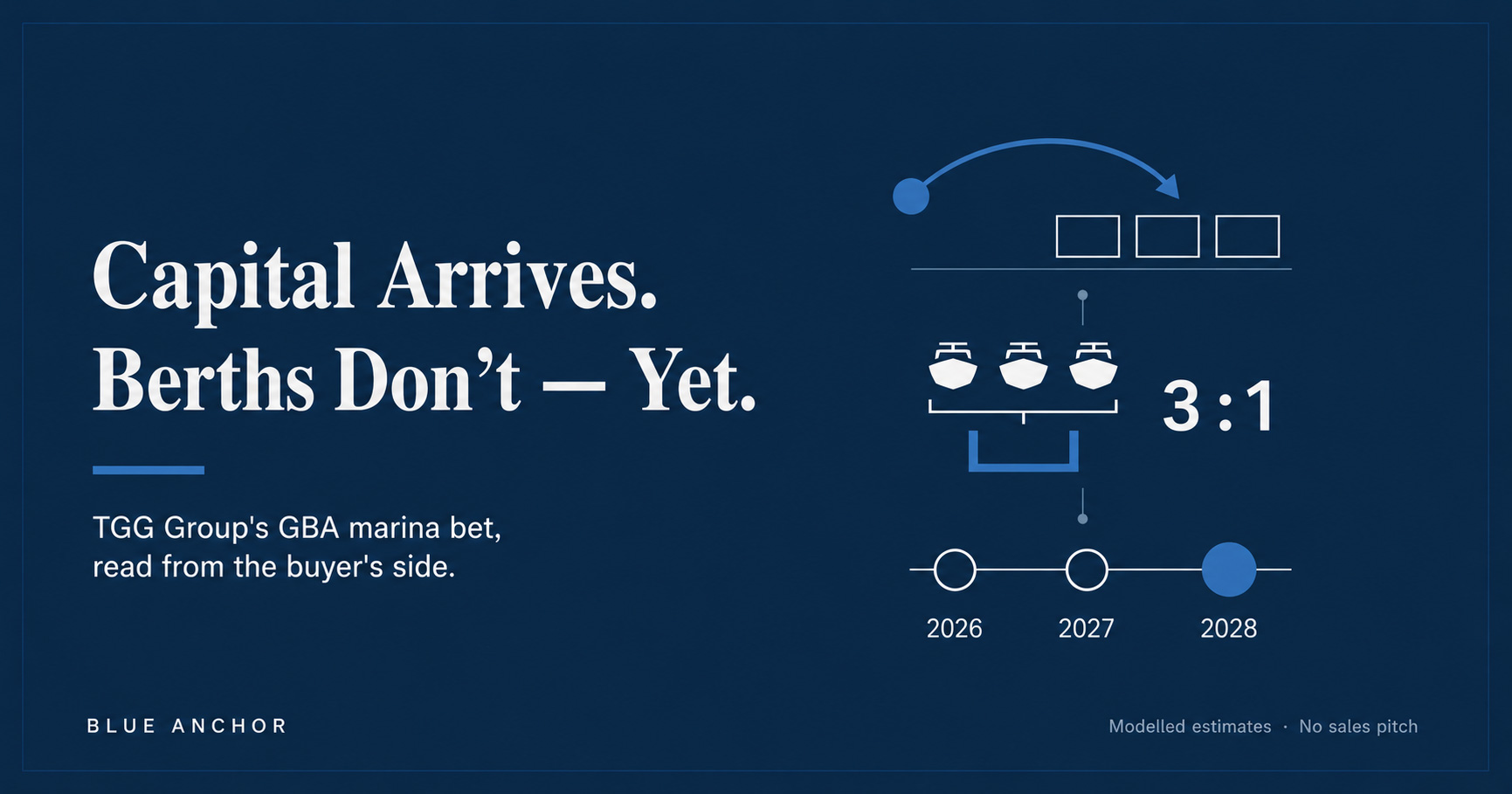
TGG Group, a Hong Kong single-family office, has invested in Central Yacht to develop marina and yachtbuilding capacity across the Greater Bay Area. Here is what the deal actually changes — and what it does not — for buyers and owners in the HK$3M–10M band.
A Hong Kong single-family office has backed the region’s best-known superyacht consultancy to develop marina and yachtbuilding capacity across the Greater Bay Area, arriving two months after Beijing scrapped the costly customs guarantee that had long blocked HK-registered yachts from mainland ports. Together, these two events confirm that institutional money and central-government policy are now pointing in the same direction — but neither yet puts a working berth under your hull.
Blue Anchor · Yacht ownership desk · 2 August 2026
On 27 July 2026, SuperYacht Times and Sail-World both reported a strategic investment by TGG Group — a Hong Kong single-family office led by Barry Lau — into Central Yacht, the Hong Kong-based superyacht design, build and operations consultancy that Captain Paul Brackley founded in 2006. Central Yacht has guided a number of Asian owners through the superyacht design and build process, and its published track record includes four deliveries averaging 60 metres in length. The stated purpose of the new capital is to accelerate marina infrastructure and yachtbuilding capacity across the Guangdong-Hong Kong-Macao Greater Bay Area. No transaction size was disclosed.
The deal landed at a moment of unusual momentum for GBA yachting. Two months earlier, on 30 May 2026, Beijing had issued a State Council directive that materially changed the economics of cross-border cruising. As reported by CGTN on 31 May 2026, the directive streamlines clearance logistics and exempts yachts registered in the Hong Kong and Macao special administrative regions from posting customs guarantee deposits when entering designated mainland cities. For the first time, HK- and Macau-registered vessels may enter nine Greater Bay Area cities — Guangzhou, Shenzhen, Zhuhai, Foshan, Huizhou, Dongguan, Zhongshan, Jiangmen and Zhaoqing — without a customs guarantee, operating instead under a temporary ship registration.
Reading these two events together as a single “GBA yachting is open for business” announcement is tempting. The reality for a buyer sitting in Hong Kong today is more layered.
According to TGG Group’s own corporate material, Barry Lau’s background spans Clifford Chance London, ABN AMRO London, BNP Paribas Hong Kong and Adamas Hong Kong, with a professional team of around twenty supporting the office. The firm describes itself as a Hong Kong-based single-family office taking concentrated positions across lifestyle, sports, media and alternative strategies. The Central Yacht investment extends that approach into marine infrastructure at precisely the point where the GBA policy environment has become permissive enough to make it commercially rational.
Central Yacht, for its part, positions itself as an independent, owner-aligned adviser across Asia-Pacific, and now also as a technical partner to shipyards and marine authorities — including work connected to Shenzhen’s emerging maritime cluster. Its stated direction is toward high-end, intelligent and more sustainable yacht and marine technology across the region.
Lazy framing. “A Hong Kong family office has invested in GBA marina development” reads as a story about berthing supply arriving soon. The honest framing: this is early-stage capital into a consultancy with a superyacht track record. No specific marina opening dates, berth counts, or mainland joint-venture sites have been publicly named. Treat it as a credible directional commitment, not a facility you can book today.
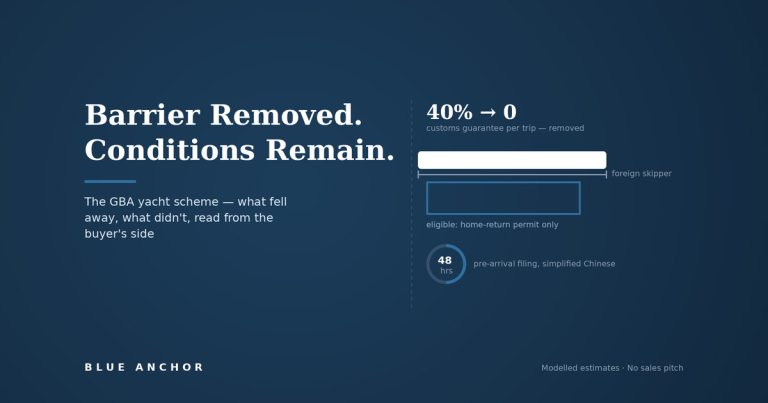
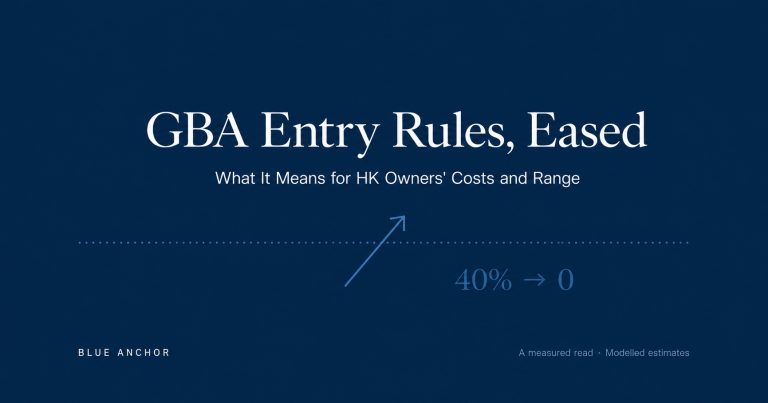
The May 2026 State Council directive is the more immediately wallet-relevant of the two events. Under the previous regime, a Hong Kong-registered yacht sailing to any mainland city had to lodge a customs guarantee reported at up to 40% of vessel value, alongside extensive paperwork. On a vessel purchased for HK$5M — the midpoint of our core reader segment — that implied tying up as much as HK$2M in a guarantee structure before leaving Hong Kong waters. The capital cost alone made casual GBA cruising financially absurd for most private owners.
Under the new arrangement, pleasure craft entering the GBA through nine designated ports are exempt from that financial guarantee, and gain a temporary ship-nationality registration that removes the need to re-flag the vessel on the mainland. Both Beijing and the HKSAR Government confirmed the change late on 30 May 2026.
On the insurance side, brokers quoted in trade coverage expect hull and third-party liability premiums to ease by roughly 5–8% as mainland clearance risk falls — though that figure is indicative and will vary by underwriter, vessel size, and the cruising area declared on the policy schedule.
What still remains. Removing the guarantee does not dissolve the requirement to complete immigration and customs clearance at a designated port of entry before navigating within a city’s jurisdiction. Industry groups continue to flag immigration procedures and visitor clearance systems as areas needing modernisation, even as Hong Kong has introduced measures to streamline arrivals for visiting yachts. The paperwork burden has shrunk; it has not disappeared.
Buyers consistently underestimate how much of their annual ownership cost is determined by where — and whether — they can reliably park the boat. The structural problem in Hong Kong is acute. Industry figures cited across 2026 coverage put the licensed fleet at roughly 12,500 vessels, including around 90 superyachts over 30 metres, against approximately 4,300 berths — a shortage that bites hardest at the larger end. At the Royal Hong Kong Yacht Club’s Shelter Cove Marina, the club’s own published position is that berths are fully occupied with a waiting list running to roughly five years across all sizes.
A consensus has formed among industry stakeholders that Hong Kong’s marina infrastructure has fallen behind regional hubs such as Singapore and Thailand: berths for larger vessels remain scarce, regulatory complexity persists, and neighbouring jurisdictions are investing heavily in their waterfronts. A participant at the Asia-Pacific Superyacht Summit in 2025 put the point bluntly, noting that Hong Kong has seen almost no infrastructure development in close to twenty years.
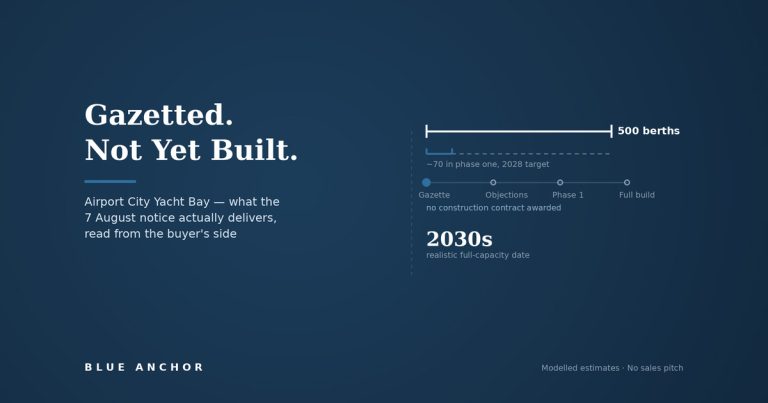
The government is responding. Benjamin Wong of InvestHK has acknowledged the berth shortage and overcrowded marinas, pointing to a plan for four new facilities — Skytopia, Hung Hom, Aberdeen and Lamma Island — adding roughly 1,200 berths in aggregate. The Airport Authority has opened international consultations on the Skytopia marina, the core marine element of its Airport City blueprint: a waterfront and marine recreation zone of around 200 hectares centred on Airport Bay Marina, intended to become the city’s largest yacht facility, ultimately providing some 500 berths including space for larger vessels. Macao News reported in April 2026 that the first phase targets completion in 2028.
Even 1,200 new Hong Kong berths against a licensed fleet of that size narrows but does not close the gap. GBA mainland berths, if the TGG–Central Yacht and other projects deliver, could effectively extend the usable berthing pool for owners prepared to clear customs and cruise north.
TGG Group’s entry is not isolated. JD.com founder Richard Liu Qiangdong has announced a personal investment of US$700 million to launch a yacht brand, Sea Expandary — his move into high-end manufacturing beyond e-commerce. Under that plan, a manufacturing base is slated for Zhuhai with a China headquarters in Shenzhen, supported by cooperation agreements already signed with the Zhuhai Municipal Government, the Shenzhen Marine Development Bureau and the Qianhai Authority. The programme extends to multiple marinas, R&D centres and service hubs across the Greater Bay Area, including three new marinas each in Zhuhai and Shenzhen.
Separately, a Zhuhai yacht maintenance facility has already relaxed its rules to allow Hong Kong and Macao vessels to sail directly into designated areas for servicing. Sector representatives told The Standard that the arrangement encourages regional exchange and delivers practical cost benefits to Hong Kong owners through lower fuel and repair prices.
For a buyer in the HK$3M–10M range, multiple competing service providers landing in the GBA within a two-year window is more interesting than any single investment announcement. Competition tends to compress haulout and service rates. Modelled conservatively, lower mainland service costs could reduce the total annual running cost of a 40–50 foot flybridge by an indicative HK$30,000–HK$80,000 per year compared with Hong Kong-only servicing — but only for owners prepared to make the passage and manage the logistics.
Central Yacht’s demonstrated expertise sits squarely in the superyacht segment — its published track record covers four vessels averaging 60 metres. The TGG investment is directed at GBA marina development and high-end yachtbuilding, not at the retail brokerage or management services that mid-market buyers in the HK$3M–10M range typically need. Buyers should not expect this deal to translate into new advisory services or managed berths for a 42-foot flybridge in the near term.
The more relevant question is whether GBA access changes the calculus of buying in this segment at all. The easing of restrictions may well stimulate investment across marina development, yacht maintenance, hospitality and marine recreation. For a buyer who values the ability to cruise to Zhuhai, spend a weekend at a GBA marina and return — and who was previously deterred by the guarantee — the May 2026 policy is genuinely liberating. For a buyer who simply wants a reliable Hong Kong home berth and local weekend cruising, the TGG announcement changes very little in the near term.
The practical risk to watch: industry leaders have warned that regulatory reform alone may not be enough, given Hong Kong’s continuing limits in marina capacity and berthing facilities, and have argued that further infrastructure investment is necessary to support any growth in yacht traffic. If policy opens demand faster than supply responds, the scramble for GBA berths could replicate Hong Kong’s existing waitlist problem on the mainland side.
Review your hull and liability insurance policy wording immediately. Confirm that the nine designated GBA cities are either already covered or that your broker can extend cover without a material premium increase — and get it in writing before making any northbound passage. Separately, contact the Hong Kong Marine Department’s eBS system or your yacht club’s marine department to obtain the current clearance checklist for northbound travel; the procedure has changed since May 2026 and older guidance circulating online may be outdated.
If you use mainland yards for haulout, the Zhuhai maintenance relaxation reported by The Standard may already reduce your cost of access. Factor this into your next annual maintenance budget — but verify the specific berth or yard is within the scheme’s geographic scope before you commit to the passage.
The policy shift makes GBA cruising access a legitimate feature to evaluate when choosing a vessel. Buyers who want to cruise to Zhuhai or Shenzhen for a weekend should model the passage fuel cost, the port fees, and the insurance endorsement cost — not just the headline removal of the customs guarantee. A boat optimised purely for Hong Kong harbour use is a different specification than one suited to extended GBA passages.
On berth planning: the Hong Kong waitlist reality has not changed. Our 2026 berthing blueprint maps the full range of options from fixed marina berths to anchorage, and the new GBA access tier is now a genuine fourth option worth modelling for the right buyer profile. Do not buy a boat expecting to solve the Hong Kong berth problem by using a GBA marina — those facilities are not yet operating at scale. Before committing, stress-test the numbers against our model-by-model ownership cost guide.
Use the tools below to run your own figures:
The GBA access narrative is now a factual feature you can cite when presenting a Hong Kong-registered vessel, particularly if it is already documented for mainland clearance. Do not overstate it: a boat that has never cleared northbound is not a “GBA-ready” boat — it is a boat that could be, subject to insurance confirmation and the buyer completing the clearance process themselves. Accurate framing preserves trust and avoids post-sale disputes.
TGG Group, a Hong Kong single-family office, invested in Central Yacht in late July 2026 to develop marina and yachtbuilding capacity across the Greater Bay Area — a credible institutional bet on a market Beijing had opened two months earlier with a State Council directive scrapping the costly customs guarantee for Hong Kong-registered yachts. The guarantee removal is the more immediately wallet-relevant change: it eliminates a deposit reported at up to 40% of vessel value before entering nine designated Guangdong cities, which had made GBA cruising financially unworkable for most private owners. Hong Kong’s core berth shortage — roughly 12,500 licensed vessels against about 4,300 berths, with some waitlists running five years — is not solved by either event, though four planned new HK marinas and multiple GBA facility projects are in the pipeline. For buyers in the HK$3M–10M band, the practical action items are: update your insurance policy wording, obtain the Marine Department’s current northbound clearance checklist, and model GBA servicing costs against Hong Kong-only maintenance before assuming the savings justify the passage.
For a full breakdown of what Hong Kong berths actually cost — fixed marina, mooring, anchorage, and now the emerging GBA tier — and how each option fits different usage patterns, see the Blue Anchor 2026 Hong Kong Berthing Blueprint.
Not automatically. The State Council’s May 2026 policy removed the customs guarantee requirement for Hong Kong-registered yachts entering nine GBA cities, but the physical berths to receive them are still being built. TGG Group’s investment in Central Yacht is aimed at accelerating that infrastructure, though no specific GBA marina opening dates or locations have been publicly confirmed. The policy opens the door; the dock is still under construction.
Previously, a Hong Kong-registered yacht had to lodge a customs guarantee reported at up to 40% of its assessed value before entering any mainland Chinese port. On a HK$5M vessel, that could mean tying up HK$2M or more in a deposit — before a single nautical mile was sailed northbound. The State Council directive of 30 May 2026 removed this requirement for designated ports in the nine approved Guangdong cities, effective immediately as confirmed by both Beijing and the HKSAR Government.
Possibly, over the medium term, if GBA capacity allows some demand to migrate northbound. Industry figures put Hong Kong’s licensed fleet at roughly 12,500 vessels against approximately 4,300 berths, with some marina waitlists running to five years or more. Any credible new supply across the GBA could ease that structural pressure. However, construction timelines are measured in years, and the four planned new HK marinas are themselves not expected to complete before 2028 at the earliest.
Central Yacht’s published track record is in superyachts averaging 60 metres — well above the HK$3M–10M buyer’s segment. The TGG investment is directed at GBA marina development and yachtbuilding, not at retail brokerage or management services for mid-market craft. Buyers in this range should seek advisers and managers whose fee structures, vessel-size experience, and service networks genuinely match what a 35–55 foot motor yacht requires day to day.
Several large initiatives are converging at the same time: the Airport Authority’s Skytopia marina (up to 500 berths, first phase targeting 2028), proposed new facilities at Aberdeen and Hung Hom, and JD.com founder Richard Liu’s US$700M Sea Expandary venture targeting marinas in Zhuhai and Shenzhen. TGG Group’s investment in Central Yacht is one piece of a broader GBA build-out that now includes both private family-office capital and large-scale industrial backing — but each project is at an early stage.
First, confirm your intended vessel will be Hong Kong-registered and that your insurer will extend hull and third-party liability cover to the nine designated GBA cities — get this in writing before purchasing. Second, review the Hong Kong Marine Department’s current northbound clearance procedure via the official eBS system, as the process changed in May 2026 and older guides circulating in clubs may be outdated. Finally, model the full annual cost including passage fuel, port fees, and any insurance endorsement before treating GBA access as a savings opportunity. Our cost calculator is a practical starting point.
Sources: SuperYacht Times, “Central Yacht secures family office investment for yachtbuilding in China’s Greater Bay Area,” 27 July 2026; Sail-World, “TGG Group invests in development of Greater Bay Area (China),” 27 July 2026; TGG Group corporate website, tgg.holdings, accessed 2 August 2026; Central Yacht corporate profiles, centralyacht.com and apsuperyacht.org, accessed 2 August 2026; CGTN, “Chinese mainland streamlines entry for Hong Kong and Macao yachts,” 31 May 2026; Hong Kong Free Press, “Beijing grants freer access to Hong Kong and Macau yachts in Greater Bay Area,” 1 June 2026; South China Morning Post, “Beijing to release Hong Kong yacht policy with mainland port details next month,” 31 May 2026; Macao News, “Hong Kong anchors its global yacht push with airport marina project,” 21 April 2026; Macao News, “Greater Bay Area yachting scheme set for expansion,” 29 April 2026; Macao News, “JD.com’s Richard Liu launches a yacht making venture in the Greater Bay Area,” 26 February 2026; Marina World, “Is Hong Kong superyacht ready?,” 2026; StartupBusiness.it, “Hong Kong and GBA: Innovation and Investment in the Yacht Economy,” 27 May 2026; The Star, “Hong Kong airport authority plans 500-berth yacht bay to promote marina tourism,” 19 April 2025; Royal Hong Kong Yacht Club, Shelter Cove Marina page, accessed 2 August 2026. Vessel and berth counts are industry-reported figures; modelled cost ranges are Blue Anchor estimates, not verified transaction data.
This article is general information for yacht owners and buyers and not regulatory, tax, or legal advice.
Our read on the policies, berthing shifts, and price moves that change yacht-buying decisions in Hong Kong — estimated market values, op-ex benchmarks, and the analysis behind them. No spam. No sales pitch. Unsubscribe anytime.