AI Valuation Audit - The Concierge Protocol
Buying a yacht in Hong Kong is a process of clearing friction layers. We are a buyer-side intelligence unit. We don’t represent sellers. We represent the math.


Industry Insight · Hong Kong
The headline is a regulatory update. The real story is more useful — and more modest — than the hype suggests. Here’s what’s actually changing for the people who own, are buying, or are selling a yacht here.
On 27 May, Transport and Logistics Secretary Mable Chan told LegCo that
preparations for the bilateral “Hong Kong yachts north, Mainland yachts
south” scheme — 港艇北上 · 北艇南下 — are progressing, with details to
be released “in due course.” She also confirmed the Marine Department’s
electronic business system will finish upgrading in June, letting visiting
yachts file crew and passenger data through a single online window for
Immigration pre-clearance.
Read at face value, it’s a procedural announcement. Read by anyone who
actually berths, refits, charters, or sells a yacht in Hong Kong, it
matters in three distinct ways: an immediate June rule change, a
cross-border scheme whose details are still pending, and the much longer
SKYTOPIA infrastructure bet. None of them, on their own, justify the
breathless “Hong Kong yacht boom” framing some of the coverage is reaching
for. Together they shift the ground enough that any thoughtful owner —
or any buyer thinking about ownership in the next 12 months — should be
paying attention.
Here is the honest read.
Buried under the “Yacht North / Yacht South” framing is a Marine Department
change that lands this June: visiting yachts will no longer
need to pre-reserve a berth at a private yacht club or marina to enter Hong
Kong waters. A dynamic yacht monitoring system will let them sail freely
and anchor in designated waters.
For visiting owners, that removes the single most-cited friction in
cruising into HK — the requirement to call ahead and beg a private club for
a slip that, in peak season, simply doesn’t exist.
For HK-flagged owners, the second-order effect is worth thinking about. A
private-club berth has historically carried two distinct kinds of value:
the slip itself, and the implicit access to HK waters it conferred on
visiting friends, family, and chartered guests. The second value is being
unbundled by the regulator. It doesn’t make existing berths less valuable
— HK berth scarcity is structural — but it does mean owners renewing club
memberships should be clear-eyed about what they’re paying for. The slip,
yes. The gate-keeping, no longer.
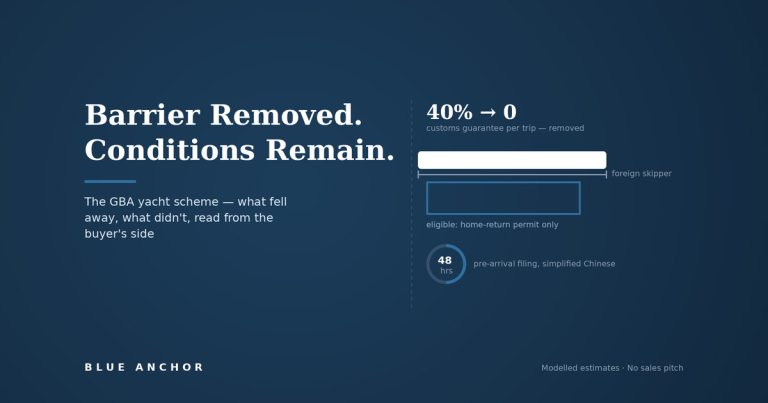
The bilateral free-travel scheme isn’t really a tourism programme. For
HK-based owners, it’s an asset-mobility play. A Zhuhai
yacht maintenance facility has already eased restrictions to accept HK and
Macau yachts for servicing, and the full scheme will normalise that
movement.
The lazy framing is “mainland refits are cheaper.” It’s true at the labour
line, but for owners in the 30m+ segment a 20% saving on antifoul isn’t
what changes their decision. The more honest framing is about access
to capacity and quality that Hong Kong physically does not have:
For mid-size owners (15–25m), the cost line does matter more —
we cover that separately in Section 5 below. But across the whole owner
base, capacity, turnaround, and specialist depth are the leading
considerations.
A side note on GBA berths
Mainland GBA cities — Zhuhai, Zhongshan, Nansha, Shenzhen — have several large marinas with available capacity, partly because mainland yacht ownership has been suppressed by the import-duty regime. For HK owners who cruise the Pearl River Delta regularly, credible mainland berthing options become a pressure valve on HK’s structural berth scarcity, not a replacement for a HK home berth.
This is the section where I want to be most careful, because the popular
framing — “HK yachts are about to surge in resale value because mainland
buyers can finally buy them” — overstates what we actually know.
Here’s the structural picture. Importing a yacht into mainland China
triggers a combined tax stack that, in current rates, lands around 38%
for motor yachts above 8 metres — duty, VAT, and consumption tax for a
luxury good. That’s why mainland yacht ownership has stayed small
relative to the wealth base, and why HK has been the regional yacht haven
for decades.
The bilateral scheme may create a path where a mainland-resident
buyer keeps the yacht on HK registry and uses it under the cross-border
mobility arrangement, never re-flagging and therefore never triggering the
import-tax stack. If that’s how the scheme is written, the realistic
buyer pool for a HK-flagged yacht widens to include wealthy GBA mainland
residents who previously couldn’t justify the tax hit.
Three honest caveats:
The realistic conclusion for a seller: if you’re planning to exit an
18–30m yacht in the next 12–24 months — the segment where mainland
interest is strongest — there’s a reasonable case for waiting until the
scheme details are public and the first cohort of cross-border
transactions has happened. The marginal additional buyer matters, but
they’re not going to bid the moon.
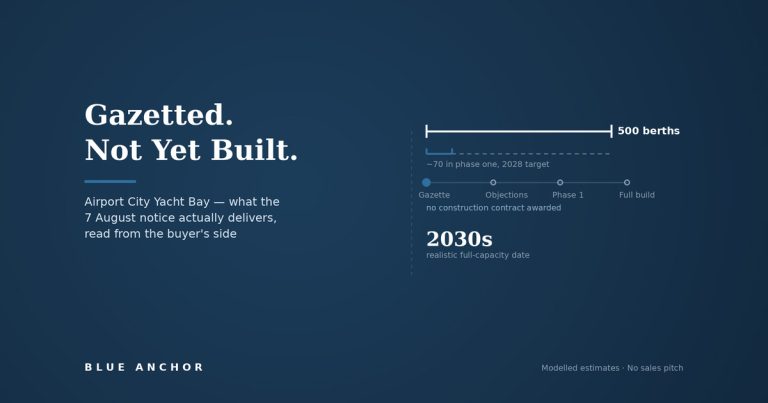
SKYTOPIA’s pitch is sea-air-land integration: land your jet at HKIA, walk
to your yacht. The marina is planned at 500 berths, half reserved for
visiting vessels, with the largest slip capable of 150m. Phase one
targets 2028, full completion 2032. The government wants the ultra-rich
superyacht owner who currently has no real reason to bring a 50m boat to
Hong Kong.
Whether it works is genuinely uncertain. Our read in brief:
Our view: partial success is the realistic case. SKYTOPIA
doesn’t displace Singapore at the top end, but it captures most of the
mainland UHNW yachting demand that currently has nowhere good to land,
and establishes HK as a credible secondary stop.
Partial success matters for current HK owners through four spillover
effects:
If SKYTOPIA underperforms, current owners are no worse off.
Nothing in your current arrangement depends on it succeeding. The June
free-anchorage rule and cross-border refit access happen regardless.
SKYTOPIA is upside optionality, not a position to hedge against.
This is the segment most of our buyer conversations sit in — wealthy
professionals, business owners, family-office principals stepping up
from a first boat or buying their first serious yacht. If that’s you,
the policy package matters in four specific ways that we’re not seeing
discussed elsewhere.
A 15–25m motor yacht’s lifetime cost is dominated by depreciation, berth
fees, and maintenance. For boats in this range, the maintenance line is
where the cross-border scheme actually moves real money. Annual servicing,
two-year haulout-and-antifoul cycles, eventual major refits at year
7–10 — all of these run on HK yards that today carry waiting lists and
price to reflect limited capacity.
Once Zhuhai is a direct sail option, a 25–30% labour-rate differential
on routine work translates to real savings over a 7-year ownership.
More importantly, it changes the viable boat size at
your budget. A buyer previously stretching at 22m because they couldn’t
confidently get a 25m serviced reliably in HK can credibly go bigger,
knowing the Zhuhai option exists as a backstop.
Build this into your purchase decision. Don’t buy on today’s maintenance
capacity. Buy on the maintenance landscape that will exist by your
second haulout cycle.
Today, a HK 15–25m buyer is choosing from a relatively thin secondary
market plus new-boat dealer stock from a handful of European builders
represented in HK. Specific spec — particular engine package, layout,
galley configuration — often means flying a boat in from Europe or
Australia, which adds 8–12% to the landed cost and 4–6 months to the
timeline.
The cross-border scheme and the broader Yacht Bay / SKYTOPIA push are
drawing more brokers, more boats, and more transactions through HK over
the next few years. For a buyer, this means a measurable improvement in
selection — particularly on the brokerage (used) side, where small
increases in inventory disproportionately improve your odds of finding
the right boat.
If the mainland buyer pool widens (with all the caveats from Section 3),
HK owners who were going to upgrade from a 20m to a 30m can do that more
easily because their existing boat now has a slightly thicker exit bid.
Practically, that means more well-maintained 18–22m HK boats
coming onto the brokerage market in 2027–2028 than would
otherwise have appeared — owners moving up rather than holding because
selling was painful.
For a buyer in the same segment, that’s a quietly important supply
effect. The boats coming onto the market are not distressed sales —
they’re upgrade-driven sales, which means well-cared-for vessels with
full service history and the previous owner motivated to close cleanly.
These are the best secondary-market boats to buy.
Buyers don’t just buy — they eventually sell. A 15–25m HK-flagged yacht
bought in 2026 will be sold in roughly 2031–2034. If the bilateral
scheme matures over that period, the mainland buyer pool will be
somewhat wider when you exit than it is today. Not transformatively, but
measurably. That’s a tailwind at your exit, not at your entry — but
it’s real, and it changes the lifetime cost-of-ownership math by a
couple of percent.
Buy now if you want the boat for the 2026 summer or autumn season, or if your real use starts before mid-2027. You’ll get two full seasons of use before any of the market effects above materially change what’s available, and waiting costs you actual time on the water.
Consider waiting through Q3/Q4 2026 if your real use starts 2027 onwards and you’re flexible on timing. By late 2026 you’ll have: scheme details published, the first cross-border refits completed and reviewable, a clearer picture of which mainland yards are credible options, and a noticeably improved brokerage selection. You’ll buy a slightly better boat for a slightly better price — but only if you have the patience to wait.
What you should not do is wait indefinitely for “the market to settle.” It won’t — these policy shifts unfold over years, and there’s no single moment after which the picture is fully clear. The 6–9 month window through end of 2026 is where the marginal information gain is highest. After that, you’re trading certainty for opportunity cost.
The June free-anchorage rule is the immediate change, and it’s a clean
win. The bilateral “Yacht North / Yacht South” scheme is the structural
change, and it matters most for how you service and eventually trade the
yacht — with the resale story being a real-but-modest tailwind that
depends on scheme details we haven’t seen. SKYTOPIA is the long bet that,
if it works even partially, quietly improves the service economy and
pricing for every HK owner — and if it doesn’t, costs current owners
nothing.
For 15–25m buyers in particular, the policy package matters more than the
coverage suggests: maintenance access expands meaningfully, brokerage
selection improves, and the upgrade pipeline from existing owners will
quietly produce a better cohort of secondary-market boats in 2027–2028.
None of this is a stampede. All of it matters to anyone who owns,
is buying, or is trading a yacht here. The owners and buyers who
treat the next 6–12 months as a positioning window will be operating
on materially better information than the ones who skim the headlines.
That is the entire point of reading carefully when the policy moves.
We do quarterly position reviews for clients across berth strategy,
refit cycle, insurance, and exit timing — and we work with buyers on
timing, segment, and spec decisions in the 15–30m range. If any of
the above applies to your situation, talk to us before the details
land.
Source reporting: RTHK (27 May 2026), Hong Kong Airport Authority SKYTOPIA briefings, Marine Department disclosures, mainland China yacht import tax schedules, and OneBlueAnchor’s own desk research. This article is general information for yacht owners and buyers and not regulatory, tax, or legal advice. Mainland Chinese yacht-related taxes and the bilateral scheme remain subject to official confirmation and may change.
Hong Kong’s Yacht North, Yacht South scheme is a bilateral arrangement allowing Hong Kong-flagged yachts to travel north into mainland waters and mainland-flagged yachts to sail south into Hong Kong, with details still pending official release. For yacht buyers, it matters in three practical ways: starting June, visiting yachts no longer need pre-reserved club berths to enter Hong Kong waters; the scheme opens access to mainland refit yards with greater capacity for larger vessels and shorter turnaround times; and it may modestly expand the resale buyer pool if mainland residents can keep yachts on Hong Kong registry without triggering the mainland import-tax stack. One Blue Anchor notes the effect is useful but measured, not transformative, with the most immediate benefit being improved asset mobility for maintenance and a potential tailwind for resale rather than a windfall.
The scheme allows Hong Kong yachts to travel into mainland waters and mainland yachts into Hong Kong. For buyers it matters through three changes: June rule removing pre-reserved berth requirements for visiting yachts, access to mainland refit yards with greater capacity and faster turnaround, and a potentially wider resale buyer pool if mainland residents can avoid import taxes by keeping yachts on Hong Kong registry.
The Marine Department rule change takes effect in June when the electronic business system finishes upgrading. Visiting yachts will no longer need to pre-reserve a berth at a private yacht club or marina to enter Hong Kong waters, and a dynamic yacht monitoring system will let them sail freely and anchor in designated waters.
Mainland yards offer access to capacity and quality Hong Kong physically lacks. Hong Kong has no dry dock large enough for a fifty-metre boat, thin marine trades, and long waiting lists. Mainland yards in Zhuhai and Shenzhen provide deeper specialist pools, available slots, and faster turnaround, reducing costly boat-out-of-service time that includes crew salaries on idle and lost use.