AI Valuation Audit - The Concierge Protocol
Buying a yacht in Hong Kong is a process of clearing friction layers. We are a buyer-side intelligence unit. We don’t represent sellers. We represent the math.


Beijing scrapped the mainland customs guarantee for HK-registered yachts on 30 May 2026, but full operating procedures, a confirmed port list, and southbound rules remain works in progress. Here is what that means for your wallet and cruising range right now.
On 30 May 2026 the State Council scrapped the mainland customs guarantee deposit for HK-registered yachts entering nine Greater Bay Area cities, and introduced a temporary ship nationality certificate so owners do not need to re-flag the vessel. The confirmed list of entry ports, the step-by-step clearance procedure for individual owners, and the rules for southbound mainland yachts visiting Hong Kong are all still being finalised by the tripartite Marine Department working group. For a buyer in the HK$3M–10M band, the change removes what was previously a decisive financial veto on northbound cruising, but does not yet deliver a friction-free weekend run to Zhuhai.
Blue Anchor · Yacht ownership desk · 2026-07-27
On the evening of 30 May 2026, China’s State Council published a directive — welcomed the same day by the HKSAR Government’s Transport and Logistics Bureau — that does two specific things: it exempts HK and Macau-registered leisure yachts from the customs guarantee deposit previously required on entry to designated ports across nine mainland GBA cities, and it introduces a temporary ship nationality registration so those vessels can operate in mainland waters without being re-flagged. As reported by the HKSAR Government press release (news.gov.hk, 30 May 2026) and confirmed by CGTN (31 May 2026), the policy took effect immediately upon publication. The South China Morning Post (31 May 2026) subsequently reported that full implementation details — including the definitive list of entry ports — were not expected to be publicly released before mid-June 2026 at the earliest.
The face-value read is seductive: an enormous new cruising ground unlocked, mainland berths suddenly accessible, and a “billion-dollar market” headline writing itself. The honest read for a buyer evaluating a HK$3M–10M purchase is more layered. The financial barrier that made northbound trips economically indefensible for most leisure owners has been removed. What remains is an implementation timeline in progress, a navigation zone that is geographically defined and monitored, and a number of owner-specific conditions — including who can actually hold the helm — that have not all been publicly resolved. The sections below unpack each piece.
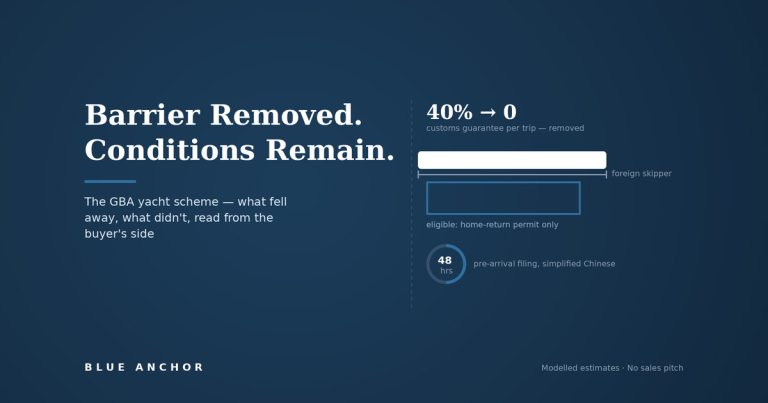
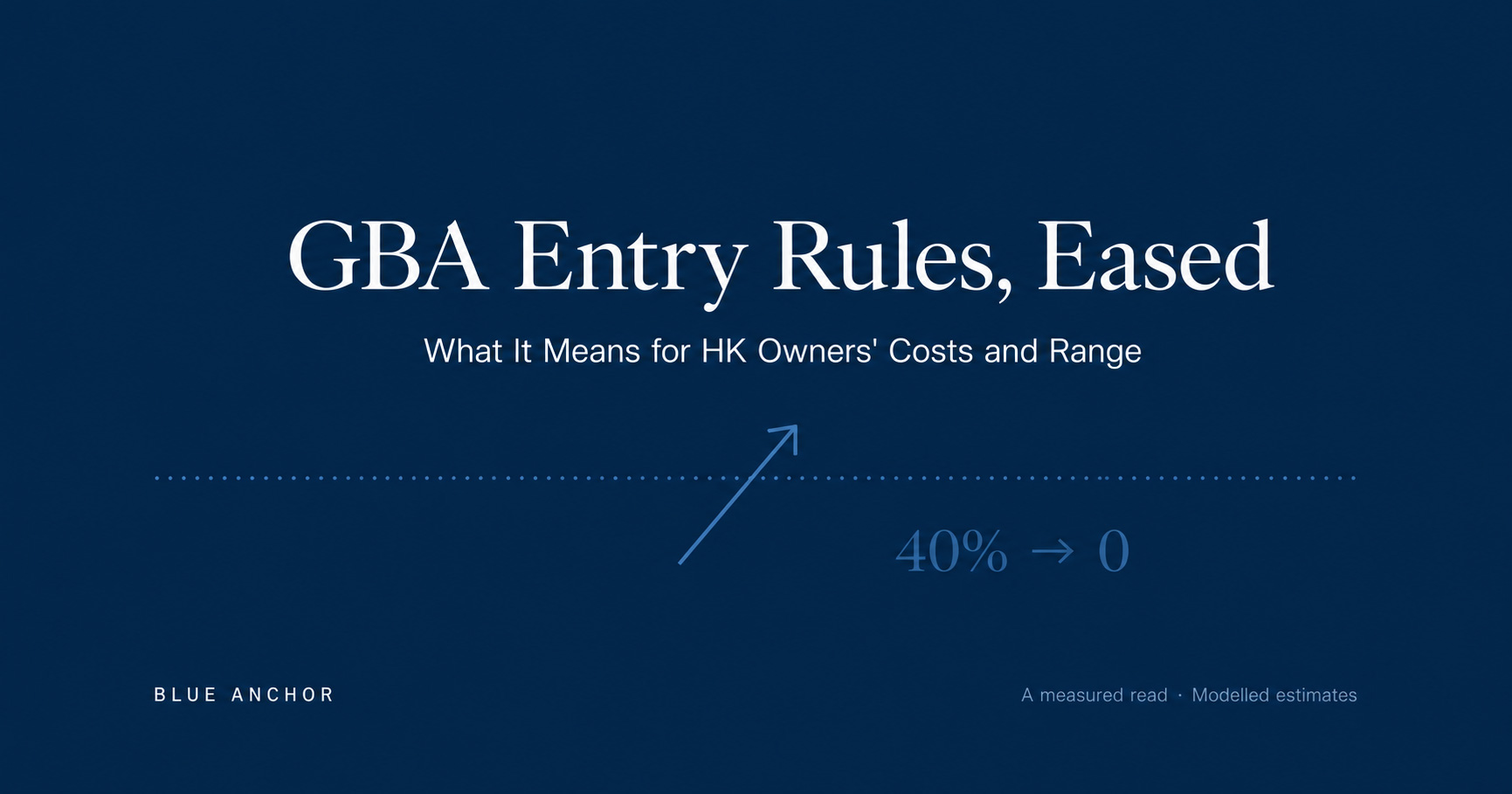
In the past, a HK-registered yacht had to pay a customs guarantee of up to 40% of its vessel value and go through extensive paperwork to sail to any city on the Chinese mainland. That headline rate is striking, but the practical bite depends on vessel value. For a buyer spending HK$5M on a mid-range flybridge motor cruiser, a 40% guarantee would have represented a HK$2M cash or surety tie-up — simply to dock at a Zhuhai marina for a weekend. Industry insiders estimated the upfront cost could reach HK$500,000 for a 60-foot boat, and critically, the guarantee had to be renewed every time the yacht left and re-entered mainland waters. That per-crossing cash drag was the real operational killer for leisure owners. It meant northbound trips were reserved almost exclusively for large commercial charters that could amortise the cost across paying guests.
Under the new policy, the Transport and Logistics Bureau noted that the exemption from the guarantee requirement will significantly reduce the financial burden on owners of HK and Macau yachts when handling cross-boundary procedures. For an owner in the HK$3M–10M range making, say, six northbound trips per year, the removal of a per-crossing guarantee renewal eliminates what was previously a structural tax on GBA cruising. The saving is real and recurring — not a one-off administrative simplification.
Lazy framing. “GBA is now open to HK yachts.” Honest framing: the financial gate has been removed for entry into nine designated city jurisdictions, but vessels must still enter and exit through approved ports, complete border clearance formalities, keep AIS transponders active, and stay within the specific waters of those nine cities. It is not open-water sailing; it is corridor access with defined entry and exit points.
The temporary ship nationality registration allows HK and Macau yachts to obtain temporary ship nationality certificates issued by the Chinese Mainland without affecting their original ship registration, enabling individual yacht travel within the waters of the nine Chinese Mainland GBA cities. This is a material operational improvement. Previously, the absence of a mainland registration created ambiguity about the legal standing of an HK-flagged vessel in Chinese waters, requiring either re-flagging or agent-mediated workarounds.
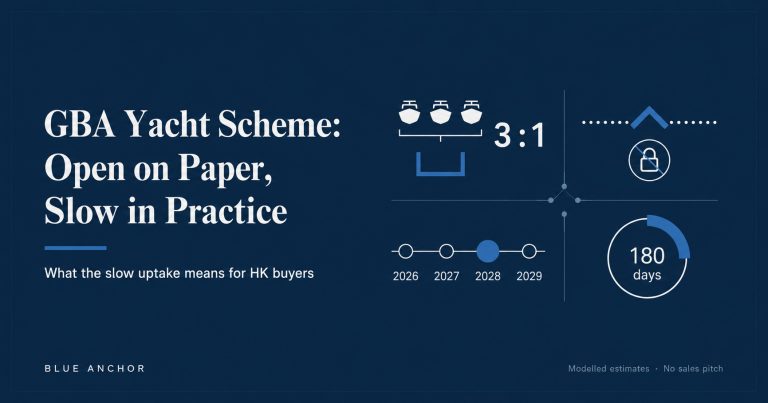
Under the draft arrangements consulted before the final directive, eligible vessels were to obtain a 180-day temporary mainland nationality certificate and keep their Automatic Identification System (AIS) transponders active at all times. Whether the 180-day validity carried through into the enacted policy has not been separately confirmed in the State Council’s published directive, but it is a practical planning number for owners seeking to understand renewal cycles. Owners should verify the current certificate term directly with the Marine Department.
For insurance, the temporary registration does not automatically extend your existing HK pleasure-craft policy into mainland waters. Most standard Hong Kong marine policies define a navigation area. Owners intending to cruise northbound should ask their underwriter to confirm — in writing — whether their hull and third-party cover applies within GBA mainland waters before the first crossing.
HK and Macau yachts that temporarily enter and exit the mainland via designated ports in nine cities and navigate only within those cities are exempt from guarantee requirements. Those nine cities are Guangzhou, Shenzhen, Zhuhai, Foshan, Huizhou, Dongguan, Zhongshan, Jiangmen, and Zhaoqing. That covers the full sweep of Guangdong’s Pearl River Delta coast — on paper, a substantial cruising ground. The practical constraint is that entry and exit must occur through specific designated ports within each city, and free-range coastal sailing between cities is not how the scheme operates.
The SCMP reported that Nansha is among the designated maritime facilities and the only one in Guangzhou, although specific locations had not yet been disclosed in the State Council directive at time of publication. An earlier Guangdong consultation document — reported by the SCMP in April 2026 and seen by VisaHQ — identified Guangzhou Nansha passenger port, Shenzhen Shekou cruise homeport, Shenzhen airport ferry terminal, Zhuhai Wanshan port, Zhuhai Jiuzhou port, and Zhongshan port as designated entry points in an initial roll-out. Owners should treat this as indicative, not exhaustive — the full confirmed port list was pending official publication as of late July 2026.
Navigation zone note. Vessels must conduct leisure activities within delineated water areas around the Pearl River Delta and Shenzhen Bay, as described in the Guangdong consultation paper reported in April 2026. Authorities retain the right to adjust these approved zones. Plan a northbound itinerary around confirmed port call points, not an assumption of unrestricted coastal roaming.
Based on the draft consultation document, only holders of mainland travel permits (home-return permits) from Hong Kong or Macau were initially eligible to captain cross-border trips; foreign passport holders were excluded. This is the condition most likely to be overlooked by buyers who focus on the cost savings and miss the operator eligibility question entirely. If your regular skipper holds a foreign passport, or if you plan to hire a professional foreign-national captain for northbound trips, the current framework as drafted does not cover them. This restriction was in the pre-announcement consultation paper; confirm whether it has been modified in the finalised procedure with the Marine Department before planning a crossing.
The chairman of the Hong Kong Yachting Association noted that in the mainland, sailing requires advance reporting to multiple departments and navigating provincial regulations. “The process is too complicated for spontaneous trips; even sailing during the day and night requires separate applications under stringent mainland regulations,” he said. For HK owners accustomed to the relative freedom of same-day decisions to sail, this cultural and regulatory gap is a practical adjustment — the new policy lowers the financial bar, but does not remove the mainland’s advance-notification culture.
The honest answer is: more so than before, but it is not yet the primary buying criterion it might become. Here is the modelled logic for a buyer considering whether GBA access should influence a purchase decision.
Before 30 May 2026, a HK$5M flybridge motor cruiser carried a theoretical guarantee exposure of up to HK$2M per northbound entry — enough to make GBA access an irrelevant feature for most leisure buyers. That number is now zero. The removal of the guarantee shifts the variable operating cost of a northbound trip to fuel, marina fees at the mainland port, and any applicable clearance charges. Guangdong has ample yacht berths and lower vessel maintenance costs than Hong Kong, while Hong Kong offers extensive international experience in yacht tourism management — meaning GBA cruising can, in theory, reduce annual maintenance spend if the boat is being serviced or stored in Guangdong during part of the year. Our ownership-cost hub covers the full operating cost structure for a vessel in this segment.
The more immediate benefit for the HK$3M–10M buyer is not the northbound trip itself — it is the maintenance cost arbitrage. Hong Kong has over 12,000 leisure vessels but only approximately 4,300 yacht berths, resulting in a persistent berth shortage. Guangdong Province is well positioned to close this gap, with an action plan published in 2024 targeting more than 2,500 new berths, over 4,000 registered yachts, and a related industry valued at more than 100 billion yuan. If you can readily send the boat north for scheduled haul-out and antifouling at GBA yards — where labour costs are materially lower — the lifetime cost of ownership improves meaningfully, independent of how often you actually cruise there for leisure.
The May 2026 policy operates in one direction only. The Marine Department is co-ordinating with the Guangdong Maritime Safety Administration on measures to facilitate southbound travel for mainland yachts to Hong Kong, with further details to be released once the arrangements are finalised. For HK buyers, this matters for a different reason than it appears. A fully reciprocal two-way scheme would create a more liquid cross-border market — mainland-registered owners with exposure to HK waters, HK charter operators with access to northbound itineraries — which would ultimately support the secondary-market liquidity of GBA-capable vessels registered in Hong Kong. That market is not yet functioning, but the groundwork is being laid.
Industry leaders have warned that regulatory reforms alone may not be enough, pointing to Hong Kong’s work still needed on immigration procedures, mooring facilities, and curating niche tourism itineraries. From a buyer’s perspective, this means the full economic case for GBA-capable ownership depends on infrastructure improvements that have been announced but not yet delivered.
Confirm with your existing insurer whether your current policy’s navigation area extends to GBA mainland waters and at what terms. Contact the Marine Department’s Guangdong-Hong Kong-Macao individual yacht travel working group for the current clearance procedure before planning any northbound trip. If your regular skipper holds a foreign passport, confirm whether they are eligible to captain a northbound crossing under the finalised rules. For maintenance decisions, northbound yard work has become meaningfully easier to execute logistically — review your next scheduled haul-out against current GBA yard rates. Our 2026 berthing blueprint covers the mooring and infrastructure context on both sides of the border.
GBA access has moved from “financially impossible for most” to “operationally possible with conditions.” It should now be a consideration in your vessel specification — but not the primary driver of the purchase. Focus first on: HK berth or mooring secured, insurance navigation area confirmed at point of sale, and the HK registration status clear. GBA capability is a useful optionality upgrade, particularly if your usage pattern includes regular maintenance trips or if you have family or business interests in the Pearl River Delta cities. It does not, however, change the fundamental ownership economics enough on its own to justify stretching the purchase budget. Use the tools below to run the full cost picture before committing.
GBA access is now a legitimately marketable feature of an HK-registered vessel, where previously it was theoretical. If your boat has been maintained to a standard that supports northbound certification — AIS fitted, HK registration current, in-survey — that story is worth telling to buyers with GBA connections or interests. Frame it as operational optionality, not a value premium; yachts are depreciating assets and the GBA rules do not change that arithmetic.
The State Council scrapped the mainland customs guarantee for HK-registered yachts on 30 May 2026, removing what was previously a deposit of up to 40% of vessel value per crossing — the single biggest financial barrier to northbound cruising. A new temporary ship nationality certificate lets HK boats operate in the waters of nine GBA cities without re-flagging, while retaining their original HK registration. The full port list, step-by-step clearance procedure, captain eligibility rules for foreign-passport holders, and the southbound reciprocal arrangement for mainland vessels are all still being finalised by the Marine Department’s tripartite working group. For a buyer in the HK$3M–10M range, the change makes GBA access a real option rather than a theoretical one — most immediately useful for maintenance cost savings at Guangdong yards — but is not yet a seamless weekend sail: advance planning, AIS compliance, and a confirmed clearance procedure remain non-negotiable prerequisites.
For a full breakdown of how GBA access fits into the total annual cost picture of HK yacht ownership — berth, insurance, maintenance, and fuel — see our Financials: Yacht Ownership Reality in Hong Kong.
The customs guarantee deposit — previously up to 40% of vessel value — has been scrapped as of 30 May 2026. However, border clearance formalities, AIS compliance, and any port or berth fees at designated mainland marinas still apply. The full fee schedule for port-side charges has not yet been publicly confirmed, so owners should budget for standard marina fees at the chosen entry port and verify current clearance costs with the Marine Department before departure.
Not dramatically at this stage. The policy applies to all HK-registered leisure vessels using designated entry ports, so it does not favour a particular size band. GBA capability is now a useful-but-optional feature rather than a primary buying criterion in the HK$3M–10M range, given that the operational details are still being finalised. If you have regular business or family interests in the Pearl River Delta cities, it shifts the calculus slightly toward a vessel kept in better cross-border readiness — good HK registration standing, AIS transponder fitted, insurance navigation area confirmed.
Based on the pre-announcement Guangdong consultation document reported by the SCMP in April 2026, only holders of mainland travel permits (home-return permits) from Hong Kong or Macau were initially eligible to captain cross-border trips, with foreign passport holders excluded. This restriction was in the draft consultation paper and has not been publicly lifted in the enacted directive. Confirm the current position directly with the Marine Department before planning any crossing with a foreign-national skipper.
The temporary ship nationality certificate is issued by mainland authorities without affecting the vessel’s original HK registration, as confirmed by the HKSAR Government’s Transport and Logistics Bureau on 30 May 2026. Insurance is a separate matter: standard HK pleasure-craft policies typically define a navigation area, and GBA mainland waters may fall outside those limits. Ask your underwriter to confirm — in writing — whether your hull and third-party liability cover applies within GBA mainland city waters before making a northbound crossing.
The State Council directive took effect on 30 May 2026, but the SCMP reported that full implementation details — including the confirmed port list and clearance procedures — were not expected before mid-June at the earliest. As of late July 2026, yacht clubs have been organising pilot crossings, but individual owners should verify the current operational readiness of specific ports and the step-by-step procedure with the Marine Department before planning a northbound trip independently.
Indirectly, and over time. CGTN reported in May 2026 that Hong Kong has over 12,000 licensed leisure vessels competing for roughly 4,300 berths. Guangdong’s 2024 action plan targets more than 2,500 additional berths in the province, and easier northbound access in principle makes those berths more accessible for HK-registered boats. However, that is a multi-year build-out and a policy framework still being finalised — not relief available today. Plan your berthing around the current HK supply and treat GBA as supplementary capacity for the medium term.
Sources: HKSAR Government press release, news.gov.hk (30 May 2026); CGTN, “Chinese mainland streamlines entry for Hong Kong and Macao yachts” (31 May 2026); South China Morning Post, “Beijing allows Hong Kong yachts to berth more easily at some mainland Chinese ports” (31 May 2026); South China Morning Post, editorial “To capitalise on yacht tourism, Hong Kong must get all hands on deck” (13 June 2026); Hong Kong Free Press, “Beijing grants freer access to Hong Kong and Macau yachts in Greater Bay Area” (1 June 2026); The Standard HK, “Hong Kong braces for wave of mainland yacht owners from July” (26 June 2026); The Star (Malaysia), “Travel scheme could allow Hong Kong, Macau yachts to sail to 6 Greater Bay Area ports” (25 April 2026); Dim Sum Daily HK, “New Mainland policy boosts access for Hong Kong and Macao yachts” (30 May 2026); HK Marine Department, “Information Notes for Masters of Visiting Yachts/Pleasure Vessels”, mardep.gov.hk (accessed July 2026).
This article is general information for yacht owners and buyers and not regulatory, tax, or legal advice.
Our read on the policies, berthing shifts, and price moves that change yacht-buying decisions in Hong Kong — estimated market values, op-ex benchmarks, and the analysis behind them. No spam. No sales pitch. Unsubscribe anytime.