AI Valuation Audit - The Concierge Protocol
Buying a yacht in Hong Kong is a process of clearing friction layers. We are a buyer-side intelligence unit. We don’t represent sellers. We represent the math.


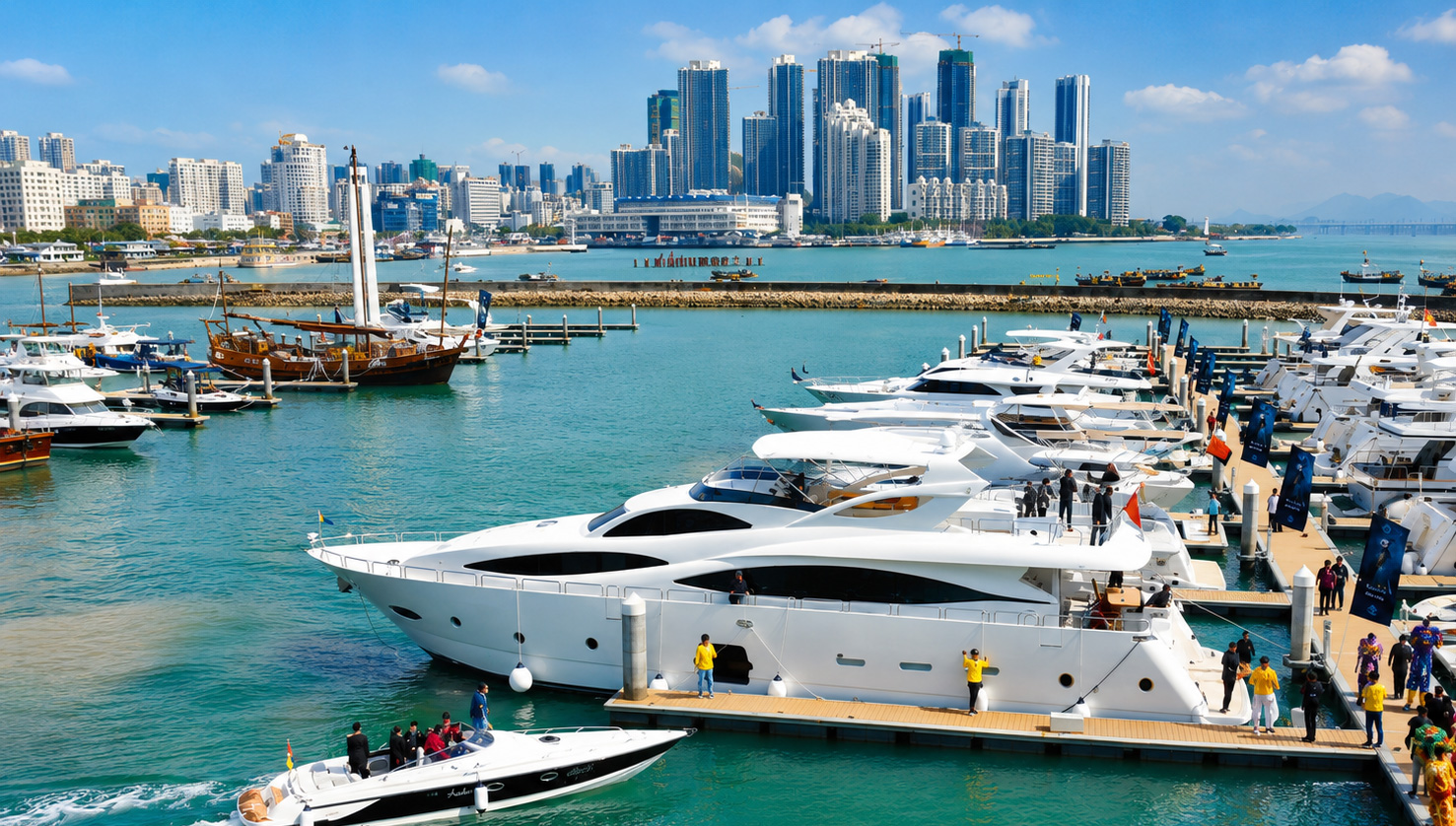
Beijing removed the costly customs guarantee for Hong Kong-registered yachts entering nine GBA mainland cities. Here is what the policy actually changes, what it does not, and how it should inform your next ownership decision.
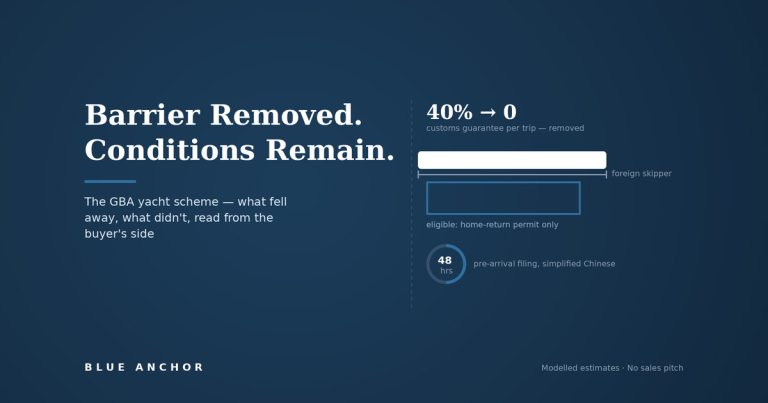
Headlines called it a “revolution” for Hong Kong yachting. The reality is more useful and more modest: Beijing has removed the customs guarantee — previously up to 40% of a vessel’s value — that was genuinely keeping most owners out of mainland GBA waters. But advance declarations, crew documentation, designated-port limits, and unfinished implementation details remain. Understanding the difference between the hype and the mechanism is what lets you make a better buying or ownership decision.
Blue Anchor · Yacht ownership desk · 2026-07-16
What happened: On 30 May 2026, China’s State Council approved the exemption of the customs guarantee requirement and the implementation of temporary ship nationality registration for Hong Kong and Macao yachts temporarily entering and exiting the Chinese mainland through designated ports in the nine Greater Bay Area (GBA) cities, provided the vessels navigate only within those cities’ waters. The State Council confirmed the pilot scheme came into effect the same day it was announced. The HKSAR Government’s response was published on the same date by the Transport and Logistics Bureau, as reported by news.gov.hk on 30 May 2026.
The face-value read is that Hong Kong owners can now take their boats to Guangzhou, Shenzhen, Zhuhai, and six other cities for a weekend cruise as easily as driving north on the highway. The more useful read — the one that matters if you are deciding what to buy, where to berth it, and how to budget for it — is that one significant friction has been removed, but a category of friction remains. What changed is financial. What has not fully changed is operational. For a first-time buyer deciding between a 40-foot day cruiser and a 50-foot passage-ready flybridge, this distinction is the whole decision.
To understand why this matters, you need to know how bad the previous system was. In the past, a Hong Kong-registered yacht had to pay a customs guarantee of up to 40% of its value and go through extensive paperwork to sail to any city on the Chinese mainland. In practical cash terms, industry insiders cited in press coverage put the upfront cost at as much as HK$500,000 for a 60-foot boat — pricing most leisure owners and corporate charter firms out of cross-border itineraries. Worse, the guarantee had to be renewed every time the yacht left and re-entered mainland waters. This was not a one-time administrative hurdle — it was a recurring capital lock-up for every single trip. The new exemption eliminates that entirely for GBA-designated ports.
The lazy framing vs. the honest framing. The lazy framing says owners now have “free access” to the mainland. The honest framing is that the financial barrier is gone, but the procedural layer is not zero: advance declarations, crew documentation, and vessel registration requirements remain, with the Marine Department and Guangdong Maritime Safety Administration still finalising full implementation details as of the date of this article.
The nine cities covered are Guangzhou, Shenzhen, Zhuhai, Foshan, Huizhou, Dongguan, Zhongshan, Jiangmen, and Zhaoqing. That sounds comprehensive, but the policy language is precise: access is through designated ports within those cities, and yachts must navigate only within those nine cities’ waters. Voyages beyond the defined GBA boundary still require full customs guarantees under the old regime.
Currently, yachts must clear mainland customs at Shenzhen Bay Marina Club before sailing onward, with advance declarations and berth reservations required. One additional port near Shenzhen Bao’an International Airport is reportedly set to be included, expanding beyond Shenzhen Bay Marina Club, which has been the only Guangdong port offering direct access to Hong Kong under the pilot policy in recent years. For buyers considering the western Pearl River Delta approach — Zhuhai, Zhongshan, the Wanshan Islands — the geography looks encouraging. For those wanting to explore beyond the defined GBA zone, nothing has changed.
The temporary ship nationality registration allows Hong Kong and Macao yachts to obtain temporary mainland certificates without affecting their original ship registration, enabling individual yacht travel within the nine GBA cities’ waters. This is the mechanism that makes the exemption work legally: your Hong Kong registration stays intact, so you are not creating dual-registration complexity or triggering a re-flagging event that could affect insurance, financing, or future resale.
There are still operational steps. Ownership documentation must be translated into simplified Chinese and uploaded to the Maritime Single Window 48 hours before arrival. The Hong Kong Marine Department, the Guangdong Maritime Safety Administration, and the Macao Marine and Water Bureau have formed a joint working group to facilitate cross-boundary leisure marine activity, and the specific list of participating ports, advance notice periods, and crew e-Channel enrolment requirements were still being finalised at the time of the announcement. Confirm current implementation details directly with the Marine Department before planning a crossing.
For the buyer in the HK$3M–10M band, this is the most practical question. Before 30 May 2026, the honest answer was: unless you had a significant appetite for paperwork and capital lock-up, a boat’s GBA capability was theoretical. Now the financial disincentive is removed, but range and sea-keeping capability still matter for the actual crossing.
The western approaches to the GBA — Zhuhai, Zhongshan, and the islands around the Pearl River mouth — are manageable open-water passages for a well-found 40-foot-plus vessel in normal conditions. A capable day cruiser with a comfortable helm can handle this in calm weather. A blue-water-capable flybridge adds margin for weather variability, better range for multi-day GBA circuits, and carries guests more comfortably on longer runs. Hong Kong has over 12,000 leisure vessels but only around 4,300 yacht berths, which means the ability to overnight in a GBA port — rather than returning to a Hong Kong berth each evening — is a genuinely useful operational capability, not just a headline feature.
The policy does not make a small day cruiser a better GBA boat. It makes the actual crossing affordable for almost any registered owner. The vessel choice still depends on what you want to do once you get there — and for multi-port GBA circuits, range, deck space, and cabin comfort remain decisive. See our Hong Kong yacht ownership cost hub for modelled running costs across vessel sizes and use profiles.
Some coverage has implied that mainland GBA marinas offer meaningful cost relief for Hong Kong owners facing the city’s chronic berth shortage. The arithmetic deserves scrutiny. The deputy manager of Nansha Marina in Guangzhou has noted that the two markets are complementary: Guangdong has ample berths and lower maintenance costs, while Hong Kong offers international experience in yacht tourism management. According to an action plan published by Guangdong’s provincial government in 2024, the province aims to build more than 2,500 new yacht berths, grow registered yachts past 4,000, and develop a related industry valued at over 100 billion yuan.
That development ambition is real — but for a Hong Kong owner wanting to permanently berth a vessel in a GBA marina, the regulatory framework for long-term northbound berthing, as opposed to occasional northbound cruising, has not been confirmed as part of this policy.
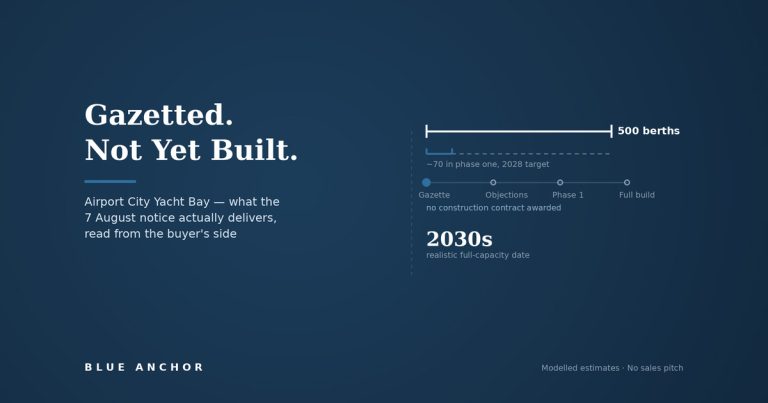
In Hong Kong itself, the berth shortage remains structural. All marina berths at RHKYC’s Shelter Cove are fully occupied with a waiting list of approximately five years across all sizes (per the club’s published marine fees page, as of August 2025), and our 2026 Hong Kong Berthing Blueprint documents waitlists of five to ten years at fixed marina berths across the city. The government’s October 2025 initiatives — 600 additional berths at the former Lamma Quarry, the Aberdeen Typhoon Shelter expansion, the Hung Hom Station waterfront project, and a planned yacht bay at Airport City — total over 1,100 planned berths, some able to accommodate yachts over 80 metres. These projects are in planning and statutory assessment stages, not available to book today. The GBA policy addresses the berth problem only at the margins of leisure usage, not as a home-berth solution.
This policy is primarily northbound — Hong Kong boats going to the mainland. But the complementary arrangement matters for the broader market. The Marine Department is coordinating with the Guangdong Maritime Safety Administration on measures to facilitate southbound travel for mainland yachts to Hong Kong, with details to be released once finalised. As law firm HFW noted in an April 2026 briefing, a workable Guangdong–Hong Kong–Macao yacht travel scheme will require detailed harmonisation of safety standards, licensing, and legal requirements.
If southbound access broadens substantially, it could increase the number of mainland-registered vessels visiting Hong Kong — adding demand to an already-constrained berth supply, and potentially affecting the liquidity profile of vessels with secured HK berths. This is a second-order effect and speculative at this stage, but worth tracking if you are sizing a purchase with an eye to eventual resale.
Check whether your current hull insurance policy extends to GBA mainland waters. Most Hong Kong-standard leisure policies specify named geographic limits; a GBA crossing may require a specific endorsement — arrange this before your first northbound trip, not after. On maintenance, the reduced crossing friction strengthens the case for sending major refit work — engine overhauls, osmosis treatment, extended hull work — to Zhuhai or Zhongshan yards. Routine servicing still belongs in Hong Kong for speed and zero transit overhead. Confirm current Marine Department crossing procedures before departure; implementation guidelines were evolving at the time of writing.
The GBA access change modestly improves the utility case for a larger, passage-capable vessel — one with range, weather margin, and cabin comfort for multi-port GBA circuits — versus a pure Hong Kong day cruiser. It does not transform the economics enough to justify upgrading solely on GBA cruising potential; the passage is still a planned event, not a daily commute. If your primary berthing plan is a Hong Kong mooring or marina slot, that constraint is unchanged and remains the hardest part of the ownership puzzle. Factor GBA access as a genuine bonus, not a core valuation driver.
The policy is a supportable talking point in any listing, but it is not a pricing catalyst. Hong Kong’s resale market is still driven primarily by berth security, vessel condition, and engine hours. A vessel that comes with a confirmed Hong Kong berth remains the scarcest and most transferable asset in this market. GBA access adds perceived range utility but does not replace the fundamental berth question. Do not price ahead of it.
On 30 May 2026, China’s State Council removed the customs guarantee — previously as high as 40% of a vessel’s value — that had made northbound GBA cruising impractical for most Hong Kong yacht owners. A temporary ship nationality registration system now allows Hong Kong-registered vessels to obtain mainland certificates without losing their original registration, enabling travel within nine designated GBA cities. The paperwork burden is reduced, not eliminated — advance filings and crew documentation remain, and full implementation guidelines were still being finalised at announcement. For buyers, the policy makes a passage-capable vessel slightly more useful, but it does not solve Hong Kong’s chronic berth shortage, and mainland berthing as a permanent home base is not confirmed. Treat it as a genuine and welcome friction reduction, calibrate your vessel choice and insurance accordingly, and wait for the Marine Department’s finalised port list before booking your first crossing.
New to the numbers behind Hong Kong ownership? Start with the financial reality of yacht ownership in Hong Kong — modelled costs, honest trade-offs, no sales pitch.
No — not for the nine designated GBA cities. On 30 May 2026 the State Council exempted the guarantee (previously up to 40% of vessel value) for Hong Kong and Macao yachts entering through designated GBA ports and navigating only within those cities’ waters. Voyages beyond the GBA boundary still fall under the old guarantee regime.
Guangzhou, Shenzhen, Zhuhai, Foshan, Huizhou, Dongguan, Zhongshan, Jiangmen, and Zhaoqing — through designated ports only, with navigation restricted to those nine cities’ waters. The finalised list of approved entry ports had not been published as of this article’s date; Shenzhen Bay Marina Club has been the primary clearance point to date.
The financial guarantee is gone, but the procedural layer remains: temporary ship nationality registration, advance declarations, crew documentation, and ownership documents translated into simplified Chinese and uploaded to the Maritime Single Window 48 hours before arrival. Confirm current requirements with the Marine Department before departure, as implementation details were still being finalised.
Not confirmed. The policy enables temporary cruising visits, not permanent northbound berthing. Guangdong’s marina capacity is expanding — the province’s 2024 action plan targets over 2,500 new berths — but the regulatory framework for using a GBA marina as a home base for an HK-registered vessel has not been established under this scheme.
Modestly. It improves the utility case for a passage-capable vessel with range and weather margin for multi-day GBA circuits, versus a pure day cruiser. It does not change the fundamentals: Hong Kong berth security remains the hardest constraint, and the vessel itself remains a depreciating asset. Treat GBA access as a bonus, not a core valuation driver.
Southbound arrangements are being coordinated between the Marine Department and the Guangdong Maritime Safety Administration, with details to be released once finalised. No implementation date has been stated. If southbound access broadens substantially, it could add demand to Hong Kong’s already-constrained berth supply — a second-order effect worth tracking for resale planning.
Sources: HKSAR Government Press Release, Transport and Logistics Bureau, 30 May 2026 (news.gov.hk and info.gov.hk); State Council announcement, 30 May 2026, as reported by Xinhua; Hong Kong Free Press, 1 June 2026; CGTN, 31 May 2026; Dimsum Daily, 30 May 2026; TravelMole, 9 June 2026; HFW legal briefing, April 2026; Chief Executive’s 2025 Policy Address, 17 September 2025; RTHK, 16 August 2025; Royal Hong Kong Yacht Club marine fees page (as of August 2025); South China Morning Post, as reported by The Star (Malaysia), 25 April 2026; The Standard (Hong Kong), 29 April 2026; Simpson Marine Asia, May 2024.
This article is general information for yacht owners and buyers and not regulatory, tax, or legal advice.
Our read on the policies, berthing shifts, and price moves that change yacht-buying decisions in Hong Kong — estimated market values, op-ex benchmarks, and the analysis behind them. No spam. No sales pitch. Unsubscribe anytime.