AI Valuation Audit - The Concierge Protocol
Buying a yacht in Hong Kong is a process of clearing friction layers. We are a buyer-side intelligence unit. We don’t represent sellers. We represent the math.


CL Yachts has completed sea trials on its first CLB65 SUV and the yacht is now in Hong Kong for private viewings ahead of a December boat show premiere. Blue Anchor breaks down what the SUV enclosed-bridge format really means for running costs, berth availability, and exit liquidity in the HK$5M–10M segment.
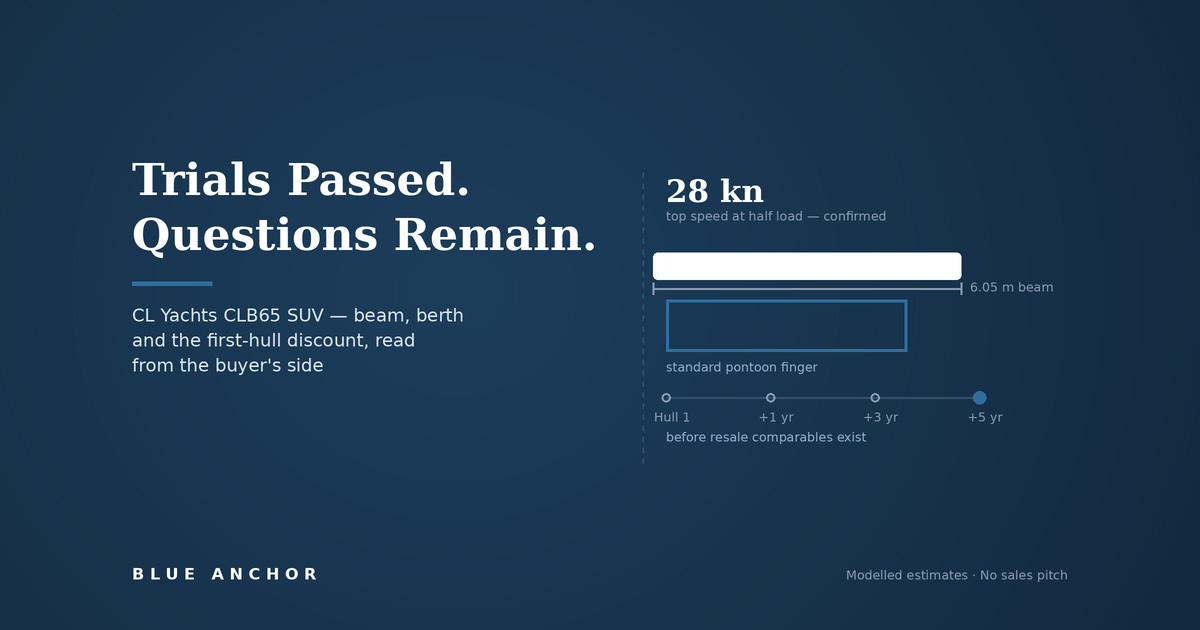
Sea trials confirmed a top speed of 28 knots at half load, and the yacht arrived in Hong Kong in August 2026 for invitation-only viewings ahead of a December boat show premiere. What changed is that performance risk is now largely answered; what did not change is that Hong Kong’s chronic berth shortage hits wide-beam vessels disproportionately, and there is still no published list price or second-hand comparator to anchor a fair-value assessment.
Blue Anchor · Yacht ownership desk · 2026-08-04
CL Yachts — the Hong Kong-based shipyard that builds at its Zhuhai facility in Guangdong province — announced in late July 2026 that sea trials of the first CLB65 SUV had been successfully completed, as reported by Skipper ONDECK Magazine and YachtBuyer. The yard confirmed the trials mark the next milestone in the development of the 19.7-metre model, which has now arrived in Hong Kong where it will be presented to selected clients and brokers. From August to November, CL Yachts will host an exclusive private viewing programme in Hong Kong, with the official Asian premiere scheduled for the Hong Kong Boat Show in December.
For a buyer who reads only the press release, this is a straightforward “new boat, comes to town” story. For a buyer weighing the HK$5M–10M segment, it is considerably more complicated. The SUV format — an enclosed-bridge, low-profile superstructure — represents a genuine shift in layout philosophy compared to the standard CLB65 flybridge. But the format also carries specific financial and logistical trade-offs that are easy to miss when you are standing inside a beautifully fitted saloon at a private preview. The three questions that matter most — what does it actually cost to berth and run, what happens to the price when you eventually want to sell, and is this the right layout for Hong Kong’s cruising conditions — deserve honest answers before any deposit is placed.
The 19.7-metre CLB65 SUV is described as a sportier and versatile evolution of the CLB65 platform, featuring an SUV-style layout designed for owner-operators. In practice, the design choice has a precise consequence: the SUV variant shares the same fundamental hull form and three-cabin, six-guest capacity as the CLB65 Flybridge, but replaces the elevated flybridge with a low-profile design, enhancing aerodynamic efficiency and reducing overall height.
That lower profile is a genuine practical benefit in Hong Kong. Air-draft clearance under bridges on the way to Tai Tam, Aberdeen, and across to Sai Kung approaches is rarely a hard constraint for a 65-footer, but reduced windage matters in typhoon season when a boat on a mooring — or in a berth — is fighting lateral load. A lower centre of effort in strong wind reduces the stress on cleats, mooring lines, and the fenders that stand between your hull and the pontoon.
Lazy framing vs honest framing. The trade press will describe the SUV layout as “more versatile.” The honest framing is that it trades the flybridge entertaining deck — a genuinely valued feature for group cruising in HK’s warm waters — for a single-level integrated saloon. If your typical usage is weekends with four to six guests who enjoy an upper-deck drinks station and open-air helm visibility, the flybridge CLB65 may serve you better. If you cruise more often in pairs or with immediate family and prefer a fully climate-controlled environment throughout, the SUV layout earns its keep.
The interior of the SUV adopts a more relaxed, integrated main-deck layout that prioritises open-plan socialising while maintaining CL’s high standard of materials and finish. Exteriors are designed by Howard Apollonio and interiors by Supertomato Studio, combining a spacious three-cabin layout with composite construction and a near-20ft beam.
During sea trials, the yacht underwent comprehensive testing validating performance, handling, and onboard systems. Powered by twin Caterpillar C18 or Volvo Penta D13 diesel engines, the CLB65 SUV delivered a top speed of 28 knots at half load, while optional features such as the ZF JMS control system further enhanced maneuverability and ease of operation.
A 28-knot top speed at half load is a solid result for a 20-metre displacement of this beam and weight. For real-world HK cruising, however, the figure that matters most is cruise economy — typically 60–70% throttle — not peak sprint speed. That figure has not been published. For enhanced manoeuvrability, the ZF JMS control system can be operated from either wing station , which is a genuinely useful feature for Hong Kong’s crowded marina approaches and typhoon shelter entries.
What “modelled” means here. CL Yachts has not published fuel consumption curves at cruise speed for the CLB65 SUV. Based on comparable twin-C18 or twin D13 installations in vessels of similar displacement, cruise fuel burn in the 150–220 litres per hour range at 18–22 knots would be a reasonable modelled working assumption — but buyers should request the builder’s own consumption data and run independent cost modelling before committing. The cost calculator linked below allows you to test different burn-rate scenarios against your planned usage.
Owners may choose RINA Hull Construction or CE Category B class certification , which gives flexibility for eventual onward delivery or sale to European or other regulated markets — a point of modest but real relevance to resale liquidity later in the boat’s life.
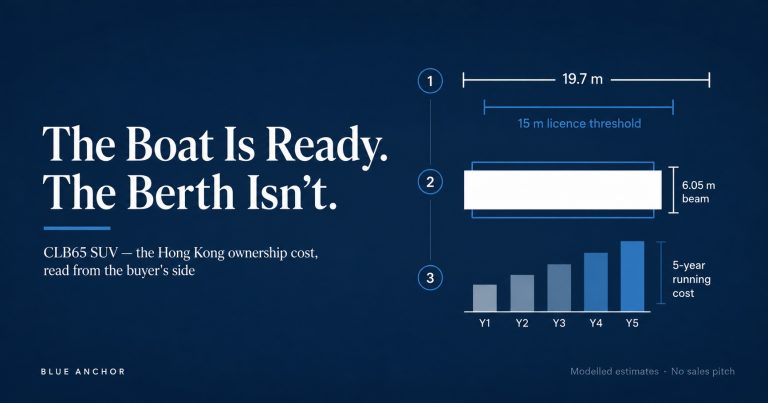
This is the section the preview programme will not cover. Measuring 19.7 metres overall, the CLB65 SUV has been designed around owner-operated cruising with a broad 6.05-metre beam. Nearly 20 feet of beam puts this vessel at the upper edge of what many Hong Kong marina pontoon fingers are spaced to accept without paying for a double-wide allocation.
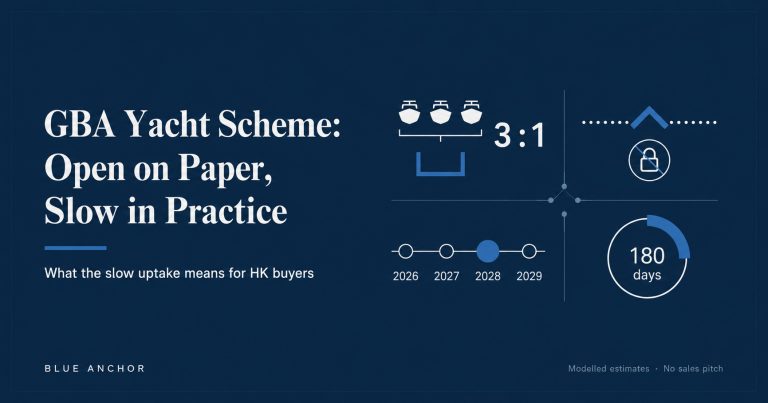
Hong Kong has approximately 12,500 licensed yachts, and these vessels compete for just 4,300 berths, creating a shortage in space for larger yachts. That ratio — roughly three boats per berth — is already acute for vessels above 50 feet. Wide-beam slots are the scarcest subset of an already scarce resource.
In practical terms, a buyer targeting the central marinas — Aberdeen Marina Club or RHKYC Kellett Island — should verify directly whether a 6.05-metre beam vessel can be accommodated before committing. Gold Coast, Hong Kong’s largest purpose-built marina with over 200 berths in Tuen Mun, can accommodate vessels up to 100 feet and offers a full facility set including a fuel dock, haul-out, and shipyard. Berth rates there run indicatively from HK$3,000–HK$12,000 per month depending on length — though beam surcharges and membership requirements mean the actual all-in cost requires a direct quote from the club.
The broader context — including mooring alternatives, typhoon shelter options, and the SkyCity marina development — is covered in our 2026 Hong Kong Berthing Blueprint.
The CLB65 SUV is hull number one of a new body-style variant. That is not a reason to avoid it — but it is a reason to be explicit about what you are accepting.
For production motor yachts broadly, yachts depreciate between 5 and 10 percent in their first year and approximately 3 to 5 percent annually after that, with many production yachts settling at roughly 50 to 60 percent of their original purchase price by the ten-year mark. Those are averages across established models with active second-hand markets. The CLB65 SUV has no second-hand market yet.
For context on the flybridge CLB65 — the closest comparator with a trading history — a 2023 CLB65 flybridge hull was listed in mid-2026 at US$2.95 million (approximately HK$23M at current indicative exchange rates) . A 2023 brand-new CLB65 was listed in Hong Kong at HK$26M. That indicative spread gives a rough two-to-three year depreciation signal for the flybridge model — useful context, but not directly transferable to the SUV variant.
Honest framing on resale. The SUV format is genuinely novel in CL Yachts’ lineup. Novelty can work either way: if the style resonates and more hulls are sold, a healthy second-hand market develops and exit liquidity improves. If production volumes remain low, finding a motivated buyer when you want to sell will be harder, and pricing will be set by negotiation rather than comparable transactions. A buyer entering hull one or two of any new model should factor this uncertainty into their exit horizon — three to five years minimum is a prudent planning assumption before expecting an efficient market to exist.
This is where the SUV layout delivers a genuine, under-discussed financial advantage over an open flybridge. A conventional flybridge requires regular canvas or glass enclosure maintenance — a full bridge enclosure can cost several thousand to well over US$10,000 to replace — plus a second helm station with its own electronics, controls, and gauges to maintain. The CLB65 SUV’s integrated superstructure eliminates the separate flybridge station entirely. That is a meaningful reduction in the number of components that can fail, corrode, or require replacement in Hong Kong’s salt-air and high-humidity environment.
On the engine side, the twin Caterpillar C18 option is a well-supported platform in Asia with established service networks, including in the Pearl River Delta adjacent to Hong Kong. Volvo Penta D13 support is also strong regionally. Neither choice introduces unusual servicing risk. At just under 20 metres, the CLB65 SUV is designed for both tropical and temperate cruising , which aligns well with Hong Kong’s typical pattern of local summer cruising and occasional longer passages toward Hainan or the Philippines.
For a worked model of what total annual ownership costs look like for a yacht in this size class in Hong Kong, the ownership-cost hub provides a structured framework covering berthing, fuel, insurance, maintenance, and survey cycles.
The private viewing window between now and November is the right moment to gather primary data, not make a decision. Specifically: request the builder’s cruise consumption curves (not just peak speed), ask for the beam confirmation in writing so you can cross-reference with your target marina’s finger-width specifications, and ask CL Yachts which classification certification — RINA or CE Category B — is being fitted to hull one and whether your hull can be specified differently. If price is discussed, treat it as a pre-show figure subject to revision once the public premiere has established market reference points in December.
If your budget sits firmly at the lower end of the HK$5M–10M band, it is worth noting that used CLB65 flybridge hulls are now appearing in the US$2.95M–US$3.95M range internationally — HK$23M–HK$31M at indicative exchange rates — with established service histories. A new SUV variant will sit above that range, and the premium buys novelty, warranty coverage, and personalised specification; it does not buy proven resale liquidity.
If you currently own a CLB65 flybridge, the SUV’s arrival is not a near-term valuation threat. The two variants serve different buyer preferences and are not direct substitutes on the second-hand market. Owners of competing models in the 55–70ft flybridge segment — Azimut, Princess, Galeon — should monitor whether the SUV format attracts step-up buyers who might otherwise be in your pool of prospective purchasers at resale. That is a three-to-five year dynamic, not an immediate pressure.
A new model launch from a well-regarded builder does draw attention to the segment and can bring fresh buyers into the market who had not previously considered a 65-foot owner-operator yacht. If your existing boat is a comparable size and spec, the increased profile around the CLB65 platform may marginally improve enquiry volume. However, your pricing will still be anchored to comparable sold transactions, not to the buzz around a first hull at preview stage.
CL Yachts completed sea trials of the CLB65 SUV and confirmed a 28-knot top speed at half load; the yacht is now in Hong Kong for private viewings running August–November, with the public premiere at the December 2026 Hong Kong International Boat Show. The enclosed-bridge SUV format offers real advantages — lower windage, a simpler maintenance profile versus a flybridge, and a fully climate-controlled single-level layout — but buyers should walk into any preview with three questions unanswered by the builder’s own materials: the published list price, the cruise-speed fuel consumption, and confirmation that their target marina has a berth wide enough for a 6.05-metre beam vessel. The resale curve for hull one of a new model is inherently unknown, so buyers who need reliable liquidity within three years should factor that uncertainty into their planning. For those with a longer horizon and a berth already secured, the CLB65 SUV is a thoughtfully engineered, regionally supported package worth a serious look.
For a full breakdown of what owning a yacht in this size class actually costs in Hong Kong — berthing, fuel, insurance, maintenance, and survey cycles modelled together — visit our Hong Kong yacht ownership financials guide.
The CLB65 SUV is a low-profile, enclosed-bridge version of CL Yachts’ 19.7-metre CLB65 platform. It replaces the open flybridge deck with a streamlined hardtop superstructure, improving aerodynamic efficiency and reducing overall vessel height. The guest capacity is the same — three cabins, up to six guests — but the deck layout and social flow are reorganised around a single integrated main deck rather than two separate entertaining levels. The enclosed format is better suited to year-round climate-controlled use; the flybridge offers more open-air entertaining space when conditions allow.
The CLB65 SUV has a beam of approximately 6.05 metres (just under 20 feet). Hong Kong has roughly 12,500 licensed yachts competing for around 4,300 berths, so wide-beam slots in central marinas are already constrained. Gold Coast in Tuen Mun is the most practical large-beam option, but buyers should confirm current berth availability directly with the club — and get the finger-width specification in writing — before signing any purchase contract. Do not assume the berth where the demo boat is moored during the preview programme is indicative of what is available for a buyer’s vessel.
CL Yachts has not published a list price for the CLB65 SUV at the time of writing. For context, a new 2023 CLB65 flybridge was listed at around HK$26M in Hong Kong; used 2023 flybridge hulls are now appearing internationally in the US$2.95M–US$3.95M range. The SUV is a new variant at preview stage, and any price discussed during the August–November private viewings should be treated as a pre-show reference, not a confirmed transaction figure. The public boat show in December will provide better market reference points.
Layout alone is not the primary driver of marine insurance premiums — underwriters focus more on hull value, engine specification, the owner’s experience level, and intended cruising area. However, if the SUV commands a price premium over the flybridge, the absolute annual premium will be higher even at the same percentage rate. Budget indicatively 0.8–1.5% of insured hull value per year as a planning figure, and confirm with a licensed Hong Kong marine insurer before committing. Hull-one status on an unrated model may attract a modest underwriting loading until claims experience accumulates.
There is no established resale data for this model; it is the first hull. Broadly, production yachts depreciate 5–10% in year one and 3–5% annually thereafter, settling near 50–60% of purchase price by year ten — but these are averages for models with active second-hand markets. Whether the SUV body style carries a liquidity premium or discount in the Hong Kong resale market will only become clear once more hulls are sold and resold, a process that typically takes three to five years for a new model. Buyers who need reliable exit options within that window should weight that uncertainty carefully.
CL Yachts is running an exclusive private viewing programme for brokers and selected clients from August through November 2026. Access is by invitation through the yard or its appointed brokers. The official public premiere is scheduled for the Hong Kong International Boat Show in December 2026, held at Club Marina Cove in Hebe Haven, Sai Kung — historically the territory’s most significant annual platform for boat buyers and dealers in the Asia-Pacific region.
Sources: Skipper ONDECK Magazine (3 August 2026, sea trials completion report); YachtBuyer (12 May 2026, sea trial confirmation; 30 March 2026, launch report); Marine Industry News (1 April 2026, CLB65 SUV first look); Pressmare (30 March 2026, launch and Hong Kong premiere schedule); CL Yachts official website, CLB65 SUV product page and news release (accessed August 2026); Asia Yacht Services marina guide (2026); Travel and Tour World / Asia-Pacific Superyacht Report 2025 data (April 2026); Aspire Yacht Sales, yacht depreciation analysis (April 2026); Asia Boating / Hong Kong broker listing, CLB65 2023 HK price (March 2024); Hong Kong International Boat Show official site (accessed August 2026).
This article is general information for yacht owners and buyers and not regulatory, tax, or legal advice.
Our read on the policies, berthing shifts, and price moves that change yacht-buying decisions in Hong Kong — estimated market values, op-ex benchmarks, and the analysis behind them. No spam. No sales pitch. Unsubscribe anytime.