AI Valuation Audit - The Concierge Protocol
Buying a yacht in Hong Kong is a process of clearing friction layers. We are a buyer-side intelligence unit. We don’t represent sellers. We represent the math.


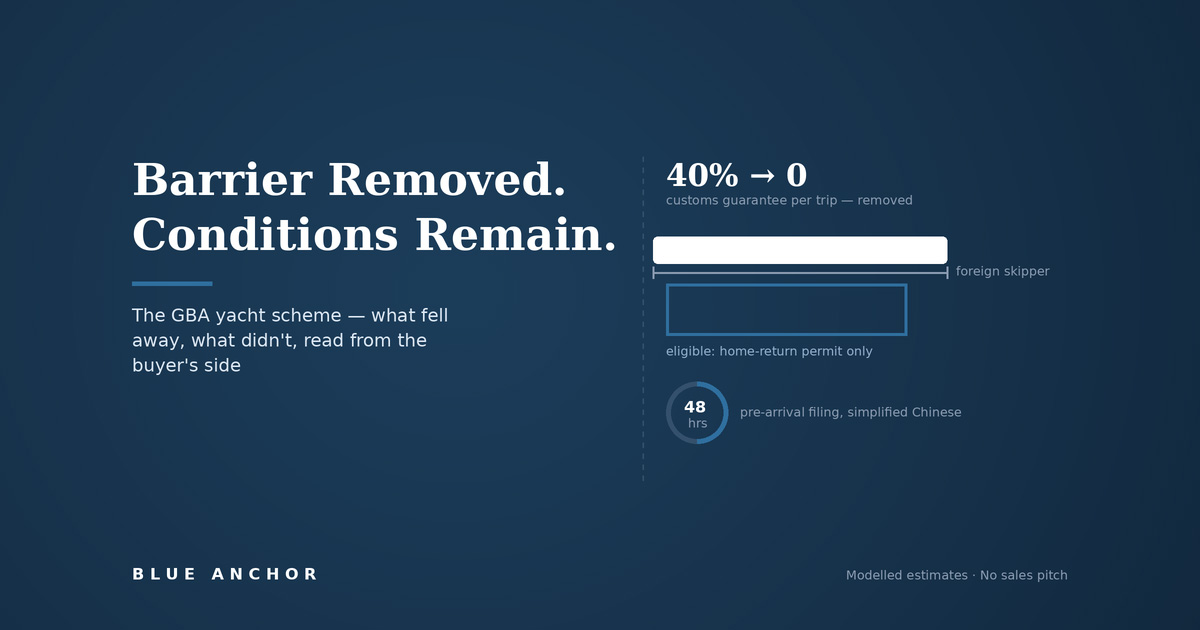
Beijing's State Council has scrapped the costly customs guarantee for Hong Kong-registered yachts entering nine GBA mainland cities. Blue Anchor unpacks what changed, what didn't, and what it means for buyers in the HK$3M–10M range.
Beijing’s State Council scrapped the customs guarantee previously required for Hong Kong-registered yachts entering nine mainland GBA cities, effective 30 May 2026 — a cost that could reach up to 40% of vessel value per trip. What did not change: the pilot applies only to designated ports, initially restricts skippering to Mainland Travel Permit holders, and still requires pre-arrival documentation filing. For a buyer in the HK$3M–10M range, the policy meaningfully widens your cruising ground and cuts a capital-tying cost, but it is not a reason on its own to buy a larger or more northbound-optimised vessel.
Blue Anchor · Yacht ownership desk · 2026-08-05
In late July 2026, a ten-vessel flotilla organised by the Royal Hong Kong Yacht Club in collaboration with the Zhuhai Yacht Association made a five-hour passage from the Causeway Bay typhoon shelter to Guishan Island in mainland waters, anchored overnight, and came home. As reported by the South China Morning Post, the flotilla was among the first groups to navigate Greater Bay Area waters under a new individual yacht travel scheme. The trip was made possible after Beijing approved the Guangdong-Hong Kong-Macau individual yacht scheme in June, allowing Hong Kong owners to sail their vessels to designated ports as part of a broader “yacht economy” strategy for the Greater Bay Area. That headline — and the cheerful seafood lunch that accompanied it — tells you the scheme is real and operational. It does not tell you what it costs to comply with, who can actually use it, or how it should change a buying decision today.
The temptation when reading this news is to frame it as a watershed moment that finally “opens” mainland China to Hong Kong yachters. The more honest framing for a buyer in the HK$3M–10M range is narrower and more useful: one large upfront cost has been removed, a parallel set of administrative requirements has appeared in its place, and the GBA is now a legitimate weekend destination rather than a regulatory minefield — but only if your vessel, your skipper’s credentials, and your home berthing are already sorted.
In the past, a Hong Kong-registered yacht had to pay a customs guarantee of up to 40% of its vessel’s value and go through extensive paperwork to sail to any city on the Chinese mainland. That figure is not abstract. On a HK$5M vessel — squarely within the buyer segment this platform serves — a 40% guarantee means HK$2M tied up in a customs bond for a single voyage. Industry sources, as reported in May 2026 analysis, indicate yacht owners had to post a bank guarantee or surety bond even for a weekend cruise, with the upfront cost potentially reaching HK$500,000 for a 60-foot boat, pricing most leisure operators and corporate charter firms out of cross-boundary travel.
The HKSAR Government welcomed the State Council’s approval of the exemption of the requirement of a guarantee and the implementation of temporary ship nationality registration for Hong Kong and Macau yachts temporarily entering and exiting the Chinese Mainland through designated ports in the nine cities of the GBA. The government confirmed the policy on 30 May 2026 via news.gov.hk. The Transport and Logistics Bureau noted that under the new policy, the exemption for the requirement for a guarantee will significantly reduce the financial burden on owners of Hong Kong and Macau yachts when handling cross-boundary procedures.
Lazy framing. “HK yachts can now sail freely into China.” Honest framing: HK-registered yachts can now enter nine specifically designated GBA mainland cities without posting a customs guarantee — a meaningful but geographically bounded privilege, not open-water freedom.
The second pillar of the policy is the temporary ship nationality registration. The temporary ship nationality registration allows Hong Kong and Macau yachts to obtain temporary ship nationality certificates issued by the Chinese Mainland without affecting their original ship registration, enabling individual yacht travel within the waters of the nine Chinese Mainland GBA cities. This matters to buyers because it means you are not forced to choose between your Hong Kong registration — which carries significant advantages in an international open-registry environment — and access to mainland waters.
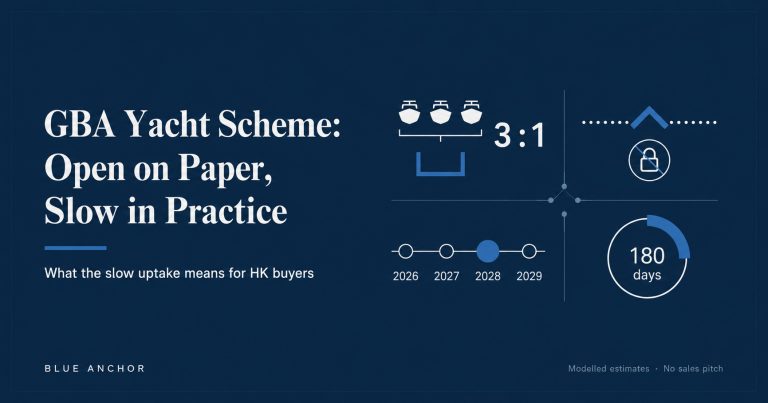
Under the draft framework, eligible vessels obtain a 180-day temporary mainland nationality certificate and must keep their Automatic Identification System (AIS) transponders active at all times. There are also pre-arrival documentation obligations: as reported in May 2026, ownership documentation must be translated into simplified Chinese and uploaded to the Maritime Single Window 48 hours before arrival. This is not an insurmountable hurdle, but it is a recurring administrative cost — in time and, if you use a documentation agent, in fees — that should be factored into any modelling of annual operating costs for a northbound-active vessel.
What “modelled” means here. Blue Anchor does not hold confirmed transaction or customs data. Any per-trip compliance cost estimate depends on vessel size, agent fees, and translation requirements. Treat all cost figures in this article as indicative planning inputs, not quotes.
This is the detail most lifestyle coverage of the scheme omits entirely. Only holders of Mainland Travel Permits (home-return permits) from Hong Kong or Macau can captain the craft initially; foreign passport holders are excluded. For a significant portion of Hong Kong’s yacht-owning community — expatriate residents and businesses that rely on foreign skippers — this is a binding constraint that the guarantee removal alone does not fix.
On the qualification side, the Marine Department has been moving in parallel. As reported by Xinhua on 29 June 2026, the three newly introduced Hong Kong-side facilitation measures include enhancing the electronic business system, relaxing the requirements of berths for visiting yachts, and facilitating masters of visiting yachts from the Chinese mainland to obtain required qualifications. The mutual recognition of operator certificates between the two jurisdictions is described in Guangdong’s 2024–2027 work plan as an objective, but as of now it remains a stated ambition rather than an operative rule. As the SCMP noted in May 2026, Hong Kong authorities may in some cases accept the RYA Yachtmaster Offshore Certificate of Competence as equivalent to the Pleasure Vessel Operators Certificate Grade 1, but this particular certificate is seldom obtained by personal sailors and is very difficult to obtain, requiring a high investment of time and money.
The policy means easier entry, less paperwork, and lower financial barriers for Hong Kong- and Macau-registered yachts traveling to Guangzhou, Shenzhen, Zhuhai, Foshan, Huizhou, Dongguan, Zhongshan, Jiangmen, and Zhaoqing — nine cities in southern Guangdong Province. Early draft planning, as reported by SCMP in April 2026, pointed to six specific entry ports including Nansha, Shekou, Shenzhen Airport Ferry Terminal, Zhuhai Wanshan, Zhuhai Jiuzhou, and Zhongshan.
The southbound side of the equation — mainland yachts coming to Hong Kong — is a work in progress. A southbound arrangement would allow mainland-registered boats to utilise ports adjacent to Shenzhen Bao’an International Airport and the Shenzhen Bay Marina Club to complete customs clearance before sailing directly to Hong Kong. For buyers, this matters because a functioning southbound flow would increase Hong Kong’s inbound marine-tourism spending and could make GBA-capable vessels more liquid at resale — though no timeline for operational southbound access has been publicly confirmed.
There are also voyage limits. The exemption currently applies only to the nine GBA cities and requires yachts to stay within those jurisdictions; voyages further up the Pearl River Delta to Guangzhou or further east toward Shantou will still need full customs guarantees.
According to the Marine Department of Hong Kong SAR and reports from the Hong Kong Commercial Daily, the city has over 12,000 leisure vessels but only 4,300 yacht berths, resulting in a berth shortage. The GBA scheme is being presented in some quarters as partial relief for this mismatch — if vessels spend weekends in Zhuhai or Zhongshan, they free up Hong Kong berths. This logic holds in the margins but should not be overstated in a buying decision.
The SCMP opinion desk, writing on 15 May 2026, noted that plans to add over 1,100 new berths and expand key sites such as the Aberdeen typhoon shelter and the former Lamma quarry show real government action on the Hong Kong side. But as we noted in our 2026 Hong Kong Berthing Blueprint, new supply is unlikely before 2027–2028 at the earliest. The GBA scheme does not alter the fundamental reality that you still need a workable Hong Kong home berth before you buy. GBA access is a weekend extension of your cruising ground, not a substitute for a home berth.
The GBA scheme affects vessel selection in one specific way: it gives a modest but real premium to boats that can navigate GBA waters efficiently — that means manageable draft for some northern Pearl River routes, reliable AIS, and documentation-ready ownership structures. For the typical HK$3M–10M buyer looking at a 38–55ft motor yacht, this is not a reason to change your target model. It is a reason to make sure ownership is structured cleanly (Hong Kong-registered, clear title, simplified Chinese documentation prepared) so that northbound trips are a one-day administrative task, not a week-long project.
The economics of GBA maintenance access also shift slightly. As our own data indicates, Greater Bay Area yards in Zhuhai and Shenzhen charge roughly HK$150–350 per hour and save 40–50% on labour compared to Hong Kong yards. If the new scheme reduces ad-hoc compliance friction for yard runs, the break-even point for using GBA yards improves modestly — though the underlying rule of thumb (two or more weeks of yard time required to justify the cross-border transit) remains broadly intact.
Confirm whether your current ownership documentation is structured to meet the pre-arrival filing requirement: translation into simplified Chinese and upload to the Maritime Single Window 48 hours before any northbound departure. If your skipper holds only a foreign passport, factor in that the pilot currently excludes foreign-passport holders from the captain’s seat — you may need to plan crew arrangements accordingly. Check with your insurer whether your existing GBA extension clause, if any, has been updated to reflect the new regulatory context. For maintenance trips to GBA yards, the reduction in customs friction is a marginal improvement to an already viable route for major refits; see our ownership-cost hub for a breakdown of when cross-border yard use makes economic sense.
The GBA scheme is a genuine incremental positive for HK-registered ownership in the HK$3M–10M range, but it should be the fourth or fifth criterion in a vessel decision — behind berth availability, hull condition, engine hours, and total annual running cost. Prioritise vessels with clean, straightforward ownership histories (simpler to translate and file), ensure AIS equipment is current, and satisfy yourself that your intended home berth is secured before factoring GBA cruising into your lifestyle calculus. If you have a Mainland Travel Permit and intend to skipper yourself, the northbound itinerary is now genuinely accessible without a capital-tying guarantee. Use the tools below to model the full cost picture before committing.
The GBA scheme adds a legitimate talking point to any vessel marketed to HK-registered buyers — clean documentation, current AIS, and Mainland Travel Permit-compatible ownership are now small but genuine selling features. Frame GBA access as widened cruising grounds, not as a financial benefit: the vessel remains a depreciating asset regardless of where it can travel. Any resale discussion should focus on liquidity and exit conditions, not on geography-driven value uplift.
Beijing’s State Council approved a policy on 30 May 2026 that removes the customs guarantee — previously up to 40% of vessel value — required for Hong Kong-registered yachts to enter nine designated GBA mainland cities, alongside a temporary nationality certificate that avoids re-flagging. The RHKYC ran the first flotilla under the operational scheme in July 2026, demonstrating the policy is live. The real constraints that remain are: geography (nine cities only, within defined ports), skipper eligibility (Mainland Travel Permit holders initially, foreign passports excluded), and a 48-hour pre-arrival documentation requirement in simplified Chinese. For buyers in the HK$3M–10M band, the scheme expands your weekend cruising range meaningfully and removes a capital-tying cost, but solving Hong Kong berthing and skipper qualifications comes first — the GBA is a feature of HK-registered ownership, not the reason to buy.
For a full breakdown of what Hong Kong yacht ownership costs annually — berth fees, insurance, maintenance, and the GBA maintenance trade-off — visit our Hong Kong yacht ownership cost hub.
No. Under the State Council approval confirmed on 30 May 2026, yachts registered in Hong Kong and Macau are exempt from the customs guarantee previously required to enter the nine designated GBA mainland cities. This is a genuine, material saving — the old guarantee could reach up to 40% of vessel value for a single trip. You will still need to file ownership documentation in simplified Chinese via the Maritime Single Window 48 hours before arrival, so the paperwork burden has not disappeared entirely, but the capital-tying requirement has.
The scheme covers nine cities in Guangdong Province: Guangzhou, Shenzhen, Zhuhai, Foshan, Huizhou, Dongguan, Zhongshan, Jiangmen, and Zhaoqing. Specific entry ports highlighted in the draft framework include Nansha, Shekou, Shenzhen Airport Ferry Terminal, Zhuhai Wanshan, Zhuhai Jiuzhou, and Zhongshan. Voyages outside these designated ports — further up the Pearl River or east beyond the GBA boundary — still require full customs guarantees.
Based on the draft policy framework reported by SCMP in April 2026, only holders of Mainland Travel Permits (home-return permits) from Hong Kong or Macau can initially captain vessels under the pilot. Foreign passport holders are excluded at this stage, which is a meaningful restriction for owners who rely on foreign skippers or crew. No public timeline for extending the scheme to foreign passport holders has been confirmed.
Indirectly and only at the margins. Hong Kong’s roughly 12,000 licensed vessels compete for only around 4,300 berths. Being able to berth in GBA ports adds theoretical overnight capacity on northbound weekends, but you still need a functional Hong Kong home berth as your base. New Hong Kong berth supply from the Aberdeen and Lamma expansion plans is unlikely before 2027–2028. The GBA scheme is an access change, not a berth supply fix.
Some industry sources suggest hull and third-party liability premiums may ease modestly now that mainland customs clearance risk has been reduced, with one indicative estimate citing a 5–8% reduction. This is an industry expectation, not a confirmed rate change, and any actual savings depend entirely on your insurer’s specific GBA coverage terms and how they underwrite the new clearance regime. Confirm with your broker before relying on this figure in any financial planning.
The scheme genuinely opens new cruising grounds and removes a significant cost barrier. However, it should not be the primary driver of a purchase in the HK$3M–10M range. Confirm that you have solved Hong Kong berthing first, that your skipper credentials are compatible with the Mainland Travel Permit requirement, and that your target vessel is appropriately equipped (AIS, clean documentation). The GBA scheme is a useful feature of Hong Kong-registered ownership — not a standalone strategy.
Sources: HKSAR Government news.gov.hk (30 May 2026); CGTN, “New policy clears way for Hong Kong and Macao yachts to enter Greater Bay Area cities” (31 May 2026); Hong Kong Free Press (31 May 2026); South China Morning Post, “New yacht travel scheme makes waves but can Hong Kong cash in on marine economy?” (late July 2026); South China Morning Post, SCMP exclusive on draft GBA pilot (April 2026); South China Morning Post opinion, “3 ways to build Hong Kong’s yacht economy beyond infrastructure” (15 May 2026); Xinhua/HKSAR Marine Department statement (29 June 2026); Macao News, “The GBA’s yacht ambitions go beyond economics” (May 2026); Guangdong Foreign Affairs Office, “HK yacht experience can benefit GBA” (November 2024); The Standard, GBA port openings commentary (April–May 2026); VisaHQ industry analysis (May 2026); TravelMole (June 2026).
This article is general information for yacht owners and buyers and not regulatory, tax, or legal advice.
Our read on the policies, berthing shifts, and price moves that change yacht-buying decisions in Hong Kong — estimated market values, op-ex benchmarks, and the analysis behind them. No spam. No sales pitch. Unsubscribe anytime.