AI Valuation Audit - The Concierge Protocol
Buying a yacht in Hong Kong is a process of clearing friction layers. We are a buyer-side intelligence unit. We don’t represent sellers. We represent the math.


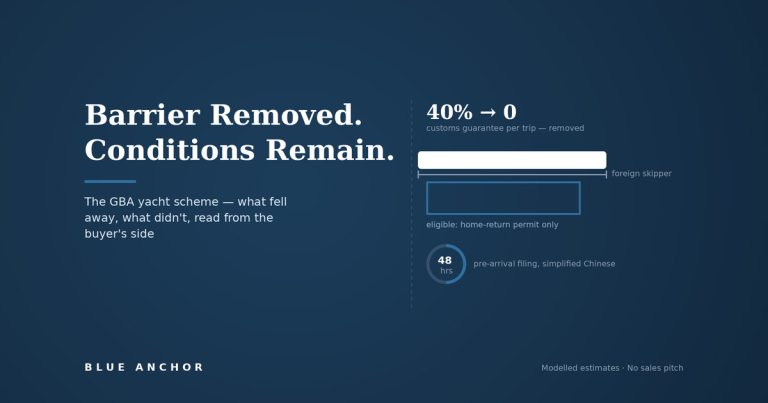
The southbound half of the GBA yacht scheme is reportedly weeks away, and mainland buyer enquiries are already surging. A measured read on what new demand actually means for Hong Kong's frozen berth supply, the used-yacht market, and the negotiating window buyers still have.
Industry Insight · Hong Kong
The southbound half of the GBA yacht scheme is reportedly weeks away, and mainland enquiries are already surging. For local buyers the net effect is directional, not dramatic: berth rights get more valuable, the negotiating window on used boats gets a clock, and “comes with transferable berth” becomes the most valuable line in any listing.
The headline says a wave of mainland yacht owners is about to lift Hong Kong’s marine economy. The real story is more modest, more specific — and for anyone buying a yacht here in the next twelve months, considerably more useful. Here’s the situation in three numbers:
Read at face value, this is a growth story for Hong Kong’s “yacht economy.” Read by anyone who actually owns, buys or sells a boat here, it’s a supply-and-demand story — and the supply side isn’t moving for at least eighteen months.
The lazy framing: more visiting yachts, more vibrancy, everyone wins. The honest framing: the scheme is explicitly expected by industry to encourage mainlanders to buy and berth vessels in Hong Kong, not merely visit — and every mainland owner who takes a Hong Kong berth or mooring is a new entrant in a queue that wasn’t moving anyway. The five visitor anchorage zones (Tai Tam, Stanley, Repulse Bay, Three Fathoms Cove, Tai O) absorb some visiting traffic, but they carry no water or shore power — they are not berth supply in any meaningful sense.
| Planned new supply | Berths | Status | Realistic timing |
|---|---|---|---|
| Aberdeen Typhoon Shelter expansion | ~200 | Funding expected 2026 | 2027 at earliest |
| Former Lamma Quarry | ~600 | Planned | Multi-year |
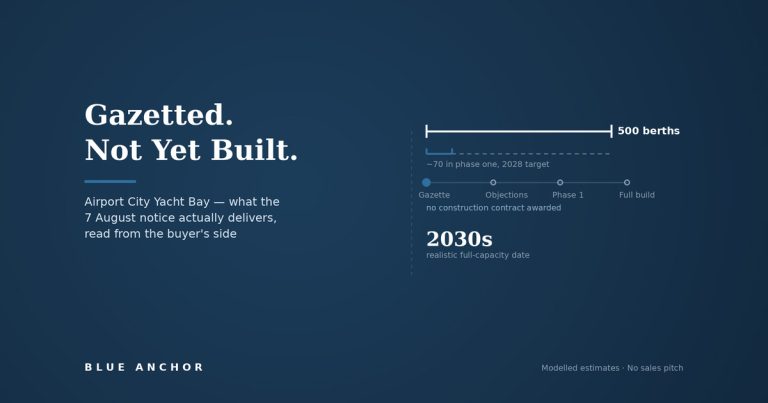
| SKYTOPIA yacht bay (Airport City) | ~500 | Phase 1 targeted 2028; half for 30m+ vessels | 2028+ |
| Hung Hom waterfront | TBC | Planned | Multi-year |
For a local buyer, the implication is mechanical: the private secondary market for moorings and club debentures — already the realistic path for most new owners — faces upward price pressure, and a boat with a genuinely transferable berth becomes more valuable relative to one without.
| Your position | Directional effect | Why |
|---|---|---|
| Owner with secured berth / transferable mooring | ▲ Stronger | Your berth right appreciates in scarcity value as new demand queues behind you. |
| Seller with boat listed | ▲ Improving | A new buyer cohort is the best news a thin market can get — if you don’t over-price ahead of it. |
| Buyer in the next 12 months | ▼ Window narrowing | Today’s negotiating room is unlikely to widen once the scheme lands; berth competition rises. |
| Buyer waiting for marina waitlists | ▼ Queue lengthens | Fixed berths were frozen before this; new demand only deepens the freeze. |
A surge at the superyacht end (LYC, 30m+ berths) tells us mainland interest is real. It does not tell us how many owners will actually berth here once they price it: Hong Kong berthing and operating costs run far above mainland equivalents, and the same GBA policy direction that opens Hong Kong southward also makes Zhuhai and Zhongshan yards — at roughly half Hong Kong rates, per industry estimates — more accessible northward. Some demand will land here; some will cruise here while the boat lives cheaper across the border. The honest position: the magnitude is unknowable today.
Pick your position:
Your berth right just became more valuable, not less. Don’t surrender it casually — if you’re upgrading boats, structure the change so the berth survives the transaction. Verify, in writing, exactly what your transfer rights are while nothing is urgent.
Sequence matters more than ever: berth path first, boat second — the berthing blueprint maps the options. On the boat itself, negotiate on today’s market data rather than tomorrow’s fear: days on market and price-cut history still describe the current balance, and they still support offers below asking. But don’t assume the current 6–15% modelled gap survives a fully-landed southbound scheme unchanged.
Your timing calculus just improved — a new buyer cohort is the best news a seller in a thin market can get. The discipline is not to over-anticipate it: a boat priced for a demand wave that hasn’t arrived yet will sit, and sitting is what erodes price. Price for today’s market; treat southbound demand as upside, not baseline.
The southbound scheme is close but not launched; mainland demand is real but unquantified; Hong Kong berth supply doesn’t move until 2027–28. Net effect for a local buyer: secure the berth path early, negotiate the boat now rather than later, and treat “comes with transferable berth” as the single most valuable line in any listing. Nothing here is a stampede — but the direction of pressure is not ambiguous.
Pricing a purchase against this backdrop? See modelled annual running costs for every popular model in our Hong Kong yacht ownership cost guide.
Source reporting: State Council announcement on GBA port berthing relaxation (late May 2026); Transport and Logistics Secretary Mable Chan, Legislative Council reply, 27 May 2026 (info.gov.hk); RTHK, 26 May 2026; The Standard, late June 2026 (Auberge Hospitality / Lantau Yacht Club enquiry reports); Marine Department visitor anchorage zone briefings, March 2026. Market figures are Blue Anchor modelled estimates from public listing behaviour, not verified transaction records.
This article is general information for yacht owners and buyers and not regulatory, tax, or legal advice.
Our read on the policies, berthing shifts, and price moves that change yacht-buying decisions in Hong Kong — estimated market values, op-ex benchmarks, and the analysis behind them. No spam. No sales pitch. Unsubscribe anytime.
For Hong Kong buyers, mainland yachts coming south under the Greater Bay Area scheme means berth rights become more valuable, the negotiating window on used boats gets narrower, and listings with transferable berths gain significant premium. One Blue Anchor notes that Hong Kong has roughly 4,300 berths competing for over 12,300 licensed vessels, with no new supply until 2027–28, while mainland enquiries are already surging ahead of the southbound scheme’s expected launch. The directional effect is that buyers shopping in the next twelve months face a tightening window before new demand lands, while owners holding secured berths see their rights appreciate in scarcity value.
It means berth rights become more valuable as new demand enters a market with no new supply until 2027–28. Buyers in the next twelve months face a narrowing negotiating window on used boats, while listings that include transferable berths gain premium value. Owners with secured berths see their rights appreciate as mainland enquiries surge.
New berth supply is not expected until 2027–28 at the earliest. The Aberdeen Typhoon Shelter expansion could add roughly 200 berths in 2027, the former Lamma Quarry project plans around 600 berths, and the SKYTOPIA yacht bay targets roughly 500 berths by 2028, with half for vessels over 30 meters.
Hong Kong currently has roughly 4,300 berths and moorings serving over 12,300 licensed vessels. Approximately two-thirds of vessels have no dedicated berth even before any new mainland demand arrives. Five visitor anchorage zones exist but carry no water or shore power, so they do not constitute meaningful berth supply.